Showing posts with label Muscadet. Show all posts

Wine Pairing Dinner - Valentine's Day


Okay, so I know that is has been a while since I have written. I will be able to explain soon, but for now, let’s just say I have been pretty busy on a big project.

Kumomotos on the half shell
Last weekend was Valentine’s Day, and like most of you, that involves flowers, chocolate, cards and a nice dinner. I find that most restaurants book up well in advance, and it is usually very crowded. This year, our group of friends decided we could do a very nice, gourmet dinner that hit all the key points of decadence, aphrodisiacs and fine wine. What follows is a 4-course meal and the wines I chose to pair with those courses.

Bacon wrapped dates
Our first course was an appetizer course of stuffed dates, wrapped in bacon. My “go to” for bacon is sparkling wine. I like how the bubbles cut the fat and grease, cleansing the palate. The dates add sweetness to the bacon, but I didn’t want to start our meal with a sweet wine. Instead, I went with a Blanc de Noir (made from more fruit forward red grapes). The wine of choice was from Schramsberg, in Napa Valley.

Oysters Rockefeller
Our second course was also an appetizer. We had oysters two ways: on the half shell and Oysters Rockefeller. Oysters are basically just little salt water exchangers, with a minerally taste to them. There are a number of classic pairings for oysters, but my "go to" is from the Loire region of France. In the coastal region of Nantes, the wines produced from the Muscadet grape mirror the brine and mineral of the oysters, but add the sharp acidity that is similar to a squeeze of lemon. The wine for this pairing was Chateau du Jaunay Muscadet Sevre et Maine.

Beef Wellington with Roasted Garlic Potatoes
Our main course was a traditional Beef Wellington. This classic English dish involves coating a tenderloin with pâté and finely chopped mushrooms, then wrapping everything in puff pastry. Since the English were (are) such big fans of French Bordeaux, the classic pairing would be a right bank Bordeaux (St. Emilion or Pomerol). These wines are mostly Merlot based. But, to complicate things, our side dishes consisted of roasted asparagus with garlic and Parmesan, as well as roasted garlic potatoes. First, asparagus makes wine taste sweeter, and garlic clashes with heavily oaked wines (think of how well garlic goes with vanilla or coconut – some of the notes that oak adds). For the wine choices, I did stick with a traditional pairing, with a bottle of 2005 Chateau Fonroque St. Emilion Grand Cru. I also had a bottle of 2012 DomaineSerene Pinot Noir Evenstad Reserve. I find that the Oregon wines are not as fruit forward as some of the California Pinot Noirs, and not as earthy as the French Burgundies. Of the two wines, I felt the Domaine Serene was the better pairing. Our hosts also opened a bottle of Calcareous Pinot Noir…heck two bottles with the main course just isn’t enough for eight people!

For our final course, we ended the evening with a Chocolate Ganache Cake. With sweet desserts, you always want your wine to be sweeter than the dessert. Despite popular belief, chocolate and wine are not natural pairings, but there are some that work well. If you are using milk chocolate, there is only one wine that I find works, and that is Brachetto d’Aqui from Italy. This is a semi-sparkling wine, with aromas of raspberries… a magical pairing with sweeter chocolate. In this case, I did not know if the cake was made sweet, or used bitter sweet chocolate, so I hedged my bets. I brought a bottle of Rinaldi Brachetto d’Aqui, along with a bottle Domaine de Paulilles Banyuls Rimage. This wine from the southern part of France, has aromas of cherries, raspberries and chocolate. It is a fortified wine, similar to Port, but with a bit lower alcohol level. As it turned out, the cake was made using a bittersweet chocolate, so the Banyuls was the best pairing.

The night progressed, and our hosts opened up a few more bottles of dessert wines that they had acquired on recent trips to Paso Robles.


As always, I hope these pairings will inspire you to try creating a fun meal on your own. You don’t need to wait for Valentine’s Day to entertain friends. Take these ideas, mix and match, and have fun!

Muscadet


Two posts ago, I shared a wine tasting event at a local restaurant. One of the white wines was Muscadet Sevre-et-Maine Sur Lie. Since most are probably not familiar with this grape, I thought I'd share a bit, in the hopes that you will seek out a bottle, and try some.

Loire Map c/o The International Sommelier Guild
Muscadet (also known as Melon de Bourgogne) is different from Muscat, which most people associate with grapey, lightly sparkling wine. There is an old story that Melon de Bourgogne arrived from Burgundy via the Valois Dukes who gave their poorest variety to the Loire as a joke. Only France would consider this a practical joke! It is thought that Muscadet is a cousin of Chardonnay. Muscadet is generally an undistinguished and neutral variety with some apple, citrus and herb notes. But with lees contact, is much improved. It also ripens early, regularly, and fairly generously, making it useful in the cool maritime climate of Loire Region in northwest France. Its' home is in the Pays Nantais region of the Loire, thanks to influence of Dutch merchants. The Dutch liked the fairly neutral grape for making Brandy.

The most significant appellation is Muscadet Sevre et Maine, which accounts for half of production in the Nantais region, though there is also Muscadet des Coteaux de la Loire in the north, and Muscadet Cotes de Grand Lieu in the south west.  Muscadet is the basic appellation for wines without lees contact. At their best, these basic Muscadet appellation wines are ordinary and pretty straight forward. The wines are generally pale with green flecks. The aromas of the Muscadet are abundant in white flowers and fruit.

Sur-lie
Typically, Muscadet vinification is done in cool stainless for the most part, and after fermentation, the wines are stored over the winter on their lees, which imparts a subtle yeastiness and, occasionally, a slight spritz.

The term "Sur Lie", which is often associated with Muscadet, translates to "aging on the lees," and often referred to as "yeast contact." Wine is aged in the barrel with the yeast retained, rather than being clarified before aging. Aging on the lees increases the complexity and creaminess of the wine. The lees function as an antioxidant but can occasionally taint the wine. Bottling is usually in the spring after the harvest—but definitely before the next harvest—it is often bottled directly from tank. The slight residues of carbon dioxide which remain after fermentation give the wines their particular freshness and special liveliness on the palate, often referred to as the ‘pearls of youth’. They also offer a great finesse and a characteristic bouquet. It is required to have 12 % or less alcohol, and a high level of acidity.

Muscadet shines as one of the great seafood wines (in particular shellfish). The classic pairing is with raw oysters. It is also wonderful with (and in) mussels à la marinière and mussel soup with saffron, and with simple grilled fish. Muscadet may have been the wine used in the original beurre blanc, a white butter sauce from Muscadet's native Pays Nantais.

The wine is designed to be consumed young and you should make a point to avoid “mature” versions of the wine

Restuarant Wine Tasting

Sometimes, the most challenging wine tasting events are the ones that don't have a theme. I just go out and purchase wines for a tasting, and it is basically whatever I felt like buying at the time. So what does a photo of quesadillas have to do with wine tasting? Keep reading....

For the last wine tasting event with the Arrowhead Wine Enthusiasts, it was a bit more challenging. For the first time, we were meeting in a restaurant whose menu featured half Mexican food and the other half was steaks and seafood. We were limited on what types of appetizers would be available for the tasting. We had steamed clams, and mussels in garlic, along with chicken tenders, onion rings, and steak quesadillas. An odd mix, but I will tell you, all the attendees felt this was one of the best tastings we had done in a restaurant. The trick was finding the right wines to work with the odd mix of hors d'oeuvres. Food pairing is always a key component to a tasting!

The steamed clams and mussels were the easiest to pair. I decided to go for a wine that most of the attendees were probably unfamiliar with, as well as one they would recognize (at least recognize the name, not necessarily the taste). For the first wine, we went with the Sauvion Muscadet Sevre-et-Maine Sur Lie Cardinal Richar. A long name for a wonderful white wine from the Nantes, in Loire France. The grape is Muscadet, or better known as Melon de Bourgogne. I'll write about this wine on my next blog.

The second wine was Mer Soleil Silver un-oaked Chardonnay from the Santa Lucia Highlands in Monterey California. While everyone is familiar with Chardonnay, they may not know what an un-manipulated Chardonnay tastes like. This crisp, clean Chardonnay was a nice pairing for the seafood, and went surprisingly well with onion rings, and the guacamole.

For the third wine, I took a risk. I have found that most people are still reluctant to try Rose, thinking they are sweet. But what better wine is there for a transition from white to red, and that can work with all types of foods? While I am a big fan of certain California Roses (those that follow this blog will know my favorites), I decided to go with a French wine from Provence. I chose the Domaine Fontanyl Rose de Provence. Very dry, with a somewhat bitter finish, but nice amounts of strawberry, cherry and watermelon on the palate.

The transition into reds was the toughest wine to choose. The challenge with Mexican food is usually the heat, and high alcohol levels can accentuate the heat. I wanted something fruity, but wanted dark red fruit. I focused in on Zinfandel (a notoriously high alcohol wine, due to high natural sugar content).  The California Sierra Foothills produce some nice jammy zinfandels. So, I looked for a low alcohol wine, and found it in the Shenandoah Special Reserve Zinfandel. There was just a little bit of Petit Sirah added, making this a fruity wine, with nice acidity, soft tannins, and just the right balance...making it a prefect pairing for the steak quesadillas.

For the last wine of the evening, I went "heavy". I chose a wine from the Duoro region of Portugal. What is the best known wine of Portugal? Port! The Quinta Do Vale Meao Meandro is made from the same grapes as your dessert Port (Touriga Nacional, Touriga Franca, Tinta Roriz, Sousão, Tinta Barroca, and Tinto Cão), except it is not fortified, so is not sweet. The wine is deep red, full, dry and fruity, but had nice balance for a big wine. In hindsight, this wine could use some air, and I would have decanted it, or opened it up well ahead of time.


Hopefully these five wines will give you some ideas on what you can do, and encourage you to explore some wines that you wouldn't normally try. Oh, and that restaurant....if you are in the Lake Arrowhead area...check out the new Borderline Restaurant in Cedar Glen. Located in an old bordello, you might just be surprised my what Ricky is offering on the menu.

Other French Wines

Whenever I talk about French wines, or do tastings, the first thought that people have is Bordeaux, Burgundy, Champagne, or maybe even some of the Rhone wines like Cotes du Rhone or Chateauneuf du Pape, but there are so many other wines and regions within France that get overlooked.

Sud Ouest, France
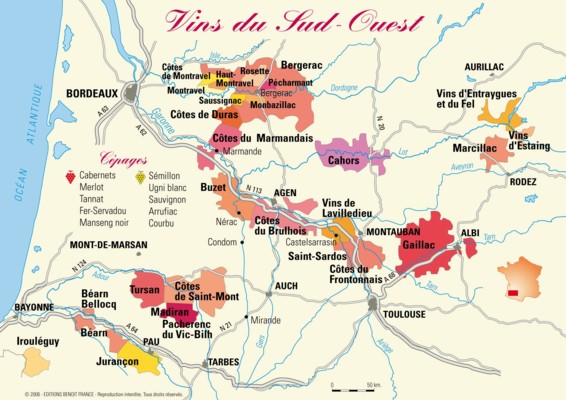
Those of you that follow this blog, have read my comments about Reislings from the Alsace region, and some of the Roses that are coming out of Provence. But some very good wines (at great prices) are coming from the lesser known regions of the Sud-Ouest (or Southwest France), which includes over 30 different AOC's.  The Sud-Ouest is the area located between Bordeaux and the Pyrennes Mountaines. Some of my favorite wines come from Jurançon, Cahors, Madiran, Irouléguy. Additionally the Loire, and Alsace don't seem to get the same attention that the better know regions of France get. Some of the finest examples of Sauvignon Blanc, Chenin Blanc and Cabernet Franc come from the Loire.

Outside of Champagne, traditional sparkling wines are called Crémant. They may or may not be made with traditional grapes, and can be very interesting variations from traditional Champagne. There are some other areas within France that do not carry the Crémant name. These areas typically make both a still and sparkling version of wine, so just go by the AOC name.

This week I conducted a wine tasting of "other French wines". The idea was to move away from the mainstream grapes and regions, and try something different....and to keep the bottle price under $20 (usually difficult for French wines). I served six wines, from some of the regions mentioned above.

The first wine was a sparkling wine: Vincent Raimbault NV Brut Vouvray. This wine comes from the Loire (Touraine district) and is made from 100% Chenin Blanc. Made in the traditional method, this straw colored wine, was bright, clean and has refreshing acidity. Aromas of lemon, grapefruit and flowers.

Muscadet
The second wine was a white wine from the Loire (the western most district of Nantais), made with the Muscadet grape (also known as Melon de Bourgogne): Pepiere 2010 Muscadet Sevre et Maine. I really liked this wine. Nice acidity, dry, a slight yeastiness due to sur lie aging. The classic wine match for Muscadet is seafood (in particular shellfish), and it worked well with the numerous shrimp dishes at the tasting, but I'd sure like to try it with some oysters!

Next was a Rosé from the Rhone region of Tavel: Mordoree 2011 Cotes du Rhone Rose La Dame Rousse. This full bodied, dry Rose was 40% Grenache, 20% Syrah, 15% Cinsault (and the rest Carignan and Mourvedre). Lots of strawberry and cherry, and savory, spice character, with a certain amount of earthiness.The finish was a bit bitter, and turned off some of the tasters, but others loved it.

The first red wine of the tasting was the Chateau du Cedre 2007 Cahors. Cahors is located in South West France just north of Toulouse. This is an ancient Roman wine producing region with evidence of vines being planted as early as 50 BC. The Cahors AOC produces red wines made with the Malbec grape (known locally as Cot or Auxerrois). Yes, Malbec was growing in France before it made a name for itself in Argentina. I would put this wine somewhere between a Cabernet Sauvignon and a Merlot. Nice plum, cherry, and cocoa aromas, and moderate tannins.

Tannat
The second red wine was the Labranche Laffont 2005 Madiran. Madiran is a small appellation, only 3,200 acres of vineyard in total, but it makes big red wines from the Tannat grape. This was a deeply colored wine with dark berry flavors and moderate tannin. The seven years of age help mellow this wine, and presented a very smooth drinking wine. Lots of positive comments about this wine, and was one of the nights' favorites.

The last red wine was very young, and required pouring through an aerator. The wine was Bernard Baudry 2010 Chinon Les Grezeaux. Chinon is the commune, in the Touraine district of the Loire, for Cabernet Franc, and an excellent value at only $22.  The wine was bottled un-fined and un-filtered after spending 12 months in neutral oak (but did have a definite oak presence on the nose). It was full-bodied and probably should be held another 5 years before opening.

So, the next time you are talking French wine, remember that not all good wines cost $60 to $3,000. Sure they are great wines, but you can also find some very good (and different) wines from some of the lesser known regions of France. Continue to explore and try...there are great finds out there!