Showing posts with label Malbec. Show all posts

Turiya Wine


I always get excited when I hear about a new winery, and taste their wines. This time was no exception. 

The best resource for finding new wineries and winemakers is from those that you already trust. I had been hearing some “buzz” about a winemaker that was doing small production, red wines, in Lompoc, California. Doing some basic research I was able to contact Angela Soleno, the winemaker and owner of Turiya Wines. We set up an appointment and met on a Monday afternoon.

Turiya is located in a warehousing area of Lompoc, not too far from the “Wine Ghetto”. When we arrived, Angela was in the process of punching down her recently harvested Sangiovese from the Stolpman vineyards. She had two large bins of red grapes fermenting: the Sangiovese, and a Cabernet Sauvignon that had recently been picked at Estelle Vineyards, right at the border of Santa Ynez, and Happy Canyon AVAs.

As we tasted some of the freshly fermenting juice, I learned a little more about Angela. She used to work as a Project Manager for Consilience Wines in Los Olivos, where she gained experience. As a single mom, raising two children, she found time to attend the Viticulture and Enology program at Allan Hancock College.  She was inspired by Stephan Asseo from L’Aventure and Eric Jensen of Booker Wines. With her contacts within the farming community, Angela secured her first fruit bill and harvest in 2008.

Turiya only produces red wines, and Angela only makes three wines a year. Two of the wines are single varieties, and the third wine is made from a blend of the two. Angela makes a very small amount of wine with each vintage, only producing as much wine as she can give her personal attention to. She said that she is constantly touching, tasting, and smelling each fermenter and barrel, making sure that the wines meet her personal style preference.

As we moved to her “tasting room” (really a cut out section within her warehouse), Angela poured the three wines from the 2008 vintage (total production of 96 cases): Cabernet Sauvignon, Syrah, and Perpetual Bliss (a blend of 60% Cab and 40% Syrah). Both varieties were sourced from the Camp 4 vineyard. She likes to be creative with her blends, combining grapes that are not traditionally blended together. Her 2009 vintage (total production of 182 cases), which was just released includes: Malbec, Petite Verdot, and Hither (a blend of 65% Petite Verdot and 35% Malbec).

All of Turiya’s wines are barrel aged for 36 months in once-used oak barrels. Versus new oak, this allows for a nice soft oak tannin flavor. She said she checks the wines after the two-year mark, but doesn’t rush the process. Once bottled, the wines age another year before release. The less manipulation, the better for Turiya. Her single variety wines are typically produced from free run juice. She allows the natural yeast to ferment, and doesn’t inoculate for malolactic fermentation (she lets the wine take its’ natural course).

The one thing you will notice right off the bat, with the wines that Angela produces, is that these are food friendly wines. The alcohol levels are lower than what we normally see in California, and the acid levels are higher. Remember our discussion about wine pairing from a past blog? Acid “excites” food and brightens flavors. These wines are intended to compliment your food pairings, and create an elegant wine and food experience.

The next thing you notice are the bottles. These are heavy bottles, with long natural cork closures. Each bottle is hand dipped in wax to seal the cork. The single variety wines have vertical labels and the blends have horizontal labels. The logo on the bottle is not your traditional paper label. Each bottle has a screen printed label made from 24k gold. Angela explained where she got the name “Turiya”…. “it is a state of consciousness, where reality and truth are the same”.

Angela wants to keep her production small, just enough for her allocation list, which is growing. The initial tasting of her fermenting 2014 Sangiovese  and Cabernet Sauvignon have me looking forward to their release in about five years. Asked what grape varieties she wants to add to her mix, Angela said she is trying to source some Anglianico.

The only way to acquire Turiya wines is by getting on the allocation list, or by visiting Turiya. Angela holds barrel tastings by appointment at her location at 316 North F Street in Lompoc. You can contact her either by email, info@turiyawines.com or phone 805.478.7016. To learn more, check out her website at www.turiyawines.com.

Turiya Wines capture the essence of a garagiste winery: small production, hands on at every step, and fine-tuned to express the winemakers style. These wines are unique, and offer the wine lover something that is different from the rest of the pack. Watch out for Angela Soleno, she could just be producing the next California “cult wine”.

Cahors = Côt = Malbec


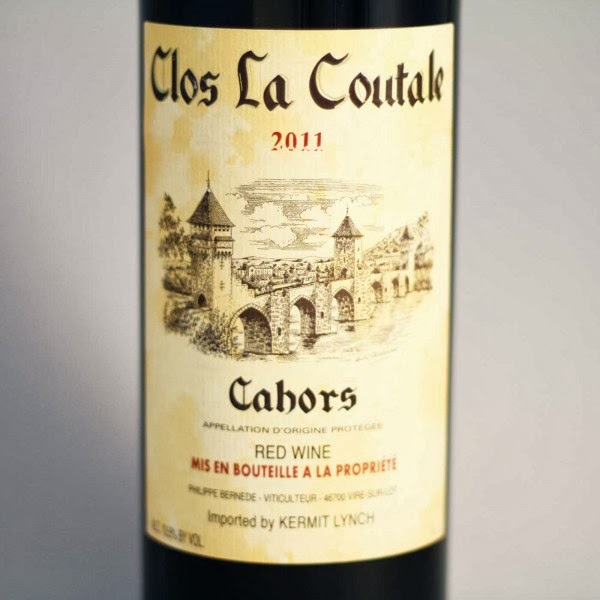
Over Christmas, my office does something called "Christmas Angel". The idea is to decorate your designated person's office space, and give them small gifts, with clues to who they are. My Christmas Angel gave me only one clue. She didn't care for wine. In my office, that actually narrowed it down quite a bit. I wrote a note to my angel saying she probably was drinking the wrong wine, and should experiment more. She proceeded to go to a local wine shop and (with help) purchased a bottle of Cahors. She knew I liked French wine, but had no idea what she bought. This got me thinking about how many people don't bother to try certain wines (particularly French wines) because they are labelled regionally, and not varietally. I have mentioned Cahors in one of my earlier blogs, but never went into much detail. So today, you get to learn a little bit about Cahors.


Cahors is the capital of the Lot department in the southwest of France (south of the better known Bordeaux region). Here, the Lot River slowly rolls along the valley floor, encircling the town of Cahors. The town was originally a Celtic settlement, prior to the Roman conquest. Cahors was also the center of commerce during the Middle Ages, and served as a crossroad for pilgrims on the trail to Santiago de Compostella, in what was then Iberia (now Spain). Today Cahors is perhaps best known as the center of the famous A.O.C. “black wine of Southwest France”.  The deeply dark, inky and earthy wines are produced from the Côt grape. Cahors was awarded A.O.C. status in 1971

Côts origin is thought to be from Quercy, centered in Cahors.  According to Janis Robinsons  great book, “Wine Grapes”, the cot grape “is a natural progeny of Prunelard and Magdeleine Noire des Charentes (the mother of Merlot). This makes Côt the half sibling of Merlot.” The Côt grape is more commonly known as Malbec—a fascinating contrast to its Argentinian brother.

In the 18th century, Cahors was considered a more prized wine than Bordeaux. Its’ sad fate was to become a blending wine for strengthening weak Bordeaux.  Côt was introduced to the Bordeaux region to add color and body to the regions wines (Cabernet Sauvignon, Merlot, Cabernet Franc and Carmeniere). At this time, the Côt grape gained its’ more recognized name, in recognition of the person that introduced, and cultivated the grape, to the region: Malbeck (now known as Malbec). Most of the Malbec vines in Bordeaux were not replanted after a devastating frost in 1956 (today, less than 2,300 acres remain). The largest plantings in France still remain in the Cahors region (around 10,000 to 12,000 acres). Compare that to Argentina, which has over 66,000 acres of Malbec planted.

The best traditional vineyards are on slopes above the river on soils of gravel, limestone and clay. The berries are large, oval, dark black, in long loose bunches, and makes a well-structured red wine which can be tannic, and is often oak aged. Traditional Cahors tends to have more raisin and tobacco flavors than the wines of Argentina, and have hidden rich fruitiness which may show up after a few years in bottle. Argentinian Malbec also tends to have smaller berries than those of Cahors. Their wines also have riper tannins (possibly due to the altitude and phenolic ripeness obtained). There are some more modern style of Cahors, which are similar to basic Bordeaux and are designed for early drinking. Given its usually reasonable price (especially when Bordeaux prices are too high), Cahors can be a great value.

Wine from the Cahors appellation must be made from at least 70% Côt (also locally known as Auxerrois or Pressac) grape, with a maximum of 30% Merlot (introduced in the 1960’s), Jurancon Noir, or Tannat grape varieties.

Thanks to Argentina, Cahors is coming back from the brink of oblivion. Be honest, how many of you even knew what Malbec was just seven years ago? Now go out and try the original: Cahors.


Other French Wines

Whenever I talk about French wines, or do tastings, the first thought that people have is Bordeaux, Burgundy, Champagne, or maybe even some of the Rhone wines like Cotes du Rhone or Chateauneuf du Pape, but there are so many other wines and regions within France that get overlooked.

Sud Ouest, France
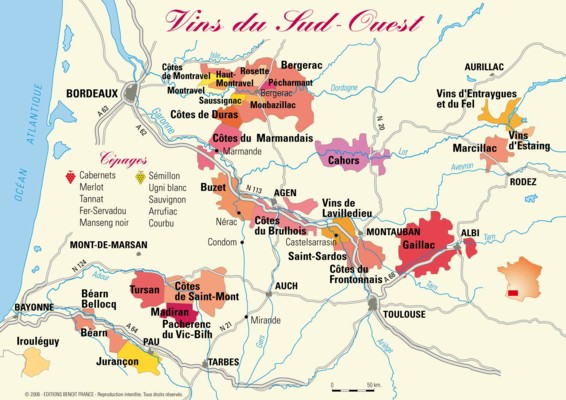
Those of you that follow this blog, have read my comments about Reislings from the Alsace region, and some of the Roses that are coming out of Provence. But some very good wines (at great prices) are coming from the lesser known regions of the Sud-Ouest (or Southwest France), which includes over 30 different AOC's.  The Sud-Ouest is the area located between Bordeaux and the Pyrennes Mountaines. Some of my favorite wines come from Jurançon, Cahors, Madiran, Irouléguy. Additionally the Loire, and Alsace don't seem to get the same attention that the better know regions of France get. Some of the finest examples of Sauvignon Blanc, Chenin Blanc and Cabernet Franc come from the Loire.

Outside of Champagne, traditional sparkling wines are called Crémant. They may or may not be made with traditional grapes, and can be very interesting variations from traditional Champagne. There are some other areas within France that do not carry the Crémant name. These areas typically make both a still and sparkling version of wine, so just go by the AOC name.

This week I conducted a wine tasting of "other French wines". The idea was to move away from the mainstream grapes and regions, and try something different....and to keep the bottle price under $20 (usually difficult for French wines). I served six wines, from some of the regions mentioned above.

The first wine was a sparkling wine: Vincent Raimbault NV Brut Vouvray. This wine comes from the Loire (Touraine district) and is made from 100% Chenin Blanc. Made in the traditional method, this straw colored wine, was bright, clean and has refreshing acidity. Aromas of lemon, grapefruit and flowers.

Muscadet
The second wine was a white wine from the Loire (the western most district of Nantais), made with the Muscadet grape (also known as Melon de Bourgogne): Pepiere 2010 Muscadet Sevre et Maine. I really liked this wine. Nice acidity, dry, a slight yeastiness due to sur lie aging. The classic wine match for Muscadet is seafood (in particular shellfish), and it worked well with the numerous shrimp dishes at the tasting, but I'd sure like to try it with some oysters!

Next was a Rosé from the Rhone region of Tavel: Mordoree 2011 Cotes du Rhone Rose La Dame Rousse. This full bodied, dry Rose was 40% Grenache, 20% Syrah, 15% Cinsault (and the rest Carignan and Mourvedre). Lots of strawberry and cherry, and savory, spice character, with a certain amount of earthiness.The finish was a bit bitter, and turned off some of the tasters, but others loved it.

The first red wine of the tasting was the Chateau du Cedre 2007 Cahors. Cahors is located in South West France just north of Toulouse. This is an ancient Roman wine producing region with evidence of vines being planted as early as 50 BC. The Cahors AOC produces red wines made with the Malbec grape (known locally as Cot or Auxerrois). Yes, Malbec was growing in France before it made a name for itself in Argentina. I would put this wine somewhere between a Cabernet Sauvignon and a Merlot. Nice plum, cherry, and cocoa aromas, and moderate tannins.

Tannat
The second red wine was the Labranche Laffont 2005 Madiran. Madiran is a small appellation, only 3,200 acres of vineyard in total, but it makes big red wines from the Tannat grape. This was a deeply colored wine with dark berry flavors and moderate tannin. The seven years of age help mellow this wine, and presented a very smooth drinking wine. Lots of positive comments about this wine, and was one of the nights' favorites.

The last red wine was very young, and required pouring through an aerator. The wine was Bernard Baudry 2010 Chinon Les Grezeaux. Chinon is the commune, in the Touraine district of the Loire, for Cabernet Franc, and an excellent value at only $22.  The wine was bottled un-fined and un-filtered after spending 12 months in neutral oak (but did have a definite oak presence on the nose). It was full-bodied and probably should be held another 5 years before opening.

So, the next time you are talking French wine, remember that not all good wines cost $60 to $3,000. Sure they are great wines, but you can also find some very good (and different) wines from some of the lesser known regions of France. Continue to explore and try...there are great finds out there!

Wines with Altitude

Some wines have attitude, and others have altitude. Yes, you read that correctly, altitude, as in elevation.

There has been some discussion on whether or not grapes grown at higher altitude, taste any different from those grown at more normal elevations. I would guess that most of you haven't really paid much attention to where you wine grapes come from, much less, how high above sea level they were grown. I decided to put together a wine tasting event of only "high altitude" wines, to see if our wine club members noticed anything different. More on that a little later.

Catena Zapata Vineyards
One challenge is that there is no set definition on what is considered "high altitude". Is an elevation of 1,000 feet high, or just a hillside?, What if you move up to 2,000 feet? Most of the research into using high altitude vineyards, is being done by Nicolas Catena (owner of Catena Zapata) in Argentina. For 20 years, he has been locating microclimates at various elevations in the Mendoza region, usually above 3,000 feet.

According to research reports,  "chemical analysis of grapes from four high-altitude vineyards supports the position that the same variety, in this case cabernet sauvignon, offers distinct aromas and flavors when cultivated at differing elevations and in varying soils."

Malbec
 "The lower temperatures and higher solar radiation at these various altitudes make for more concentrated flavors in the wines," Catena explains. "Cabernet Sauvignon samples in the test included fruit from the Uxmal Vineyard at 3,100 feet above the Mendoza Valley in the Agrelo district, which was ripe with blackberry and cassis aromas and flavors; the same variety and clone from the Domingo Vineyard, at 3,700 feet, showed more spice and black pepper intensity. There is also a thought that the UV rays are better able to penetrate the skins of the grape, and actually ripen the pips, so you end up with riper tannins. Additionally, the skins grow thicker in response to the UV light and lower temperatures, again allowing richer extraction during skin soaking and fermentation. This would lead to a higher intensity of phenolics (such as quercetine and resveratrol). This is typical of  grapes grown in stressful conditions.  The "stressful conditions" associated with high altitude are lower temperatures, higher UV radiation and  light intensity, less oxygen and carbon dioxide, and shorter growing seasons. For a full report on the findings in a 2007 symposium check out this article: Exploring High Altitude Viticulture.

Etna Rosso
Phenolics are the naturally occurring chemical compounds found in grapes, which give a wine its profile. These include the flavor and color compounds and tannins, as well as hundreds of other complex chemical components which are vital to a wine's character.

Currently, the highest vineyards in the world are located in Argentina. They are located in the Salta region, and are located in the Altura Maxima vineyard at 9,849 feet. The wines are produced by Hess, under the name of Colomé.Another vineyard has been planted further up the mountain at 10,206 feet, and should be ready for it's first harvest this year.

Back to our wine tasting....the biggest challenge was finding wines to taste. Most wineries do not mention the altitude of their vineyards, so plenty of online research was done before heading to the wine shop. I knew that Argentinian wines would be on the menu, so Malbec, and Torrontes were a given. The highest vineyards in Europe had to be in the Alps, Dolomite, or Pyrenees mountain ranges, but I found the highest vineyards are actually located on Mt Etna, on Sicily in Italy (elevation of 10,992ft, with vineyards at around 3,600 ft.)

In the United States, I focused in on the Napa and Sonoma regions, looking at areas like Lake County AVA (vineyards at 2,000 to 2,400ft), Howell Mountain (1,600 to 2,200ft), Spring Mountain (2,000ft), Mount Veeder (400 to 2,600ft), Atlas Peak (1,400 to 2,400ft), Diamond Mountain (1,200 to 2,100ft) and Sonoma Mountain (600 to 2,400ft).

We ended up tasting the following wines: Fabres Montmayu Phebus Torrontes '10 (vineyards at 3,000ft); Chateau Chevalier Spring Mountain Sauvignon Blanc '06 (vineyards at 1,000ft); Tenuta della Terre Nere Etna Rosso '10 (vineyards at 2,200ft); Bodega Catena Zapata Malbec '08 (vineyards at 5,000ft); Don Miguel Gascon Malbec '09 (vineyards range between 2,000 and 5,000ft); Alterra Howell Mountain Cabernet Sauvignon '04 (vineyards between 1,400 and 2,200ft); and Smith-Madrone Spring Mountain Cabernet Sauvignon '04 (vineyards between 1,300 and 1,900ft).

Smith-Madrone Vineyards
The results of the tasting....positive comments on all the wines. Based on how fast they lasted, the most popular wines were the Gascon Malbec and the Smith-Madrone Cabernet Sauvignon. The challenge with high altitude tastings is, there was no way to compare low elevation with high elevation, as the choices the winemaker makes during vinification would affect the final product. Personally, I felt that each wine had a little more fruit forward nose, and each had nice structure. I really enjoyed the Chateau Chevalier, the Tenuta delle Terre Nere, and the Smith-Madrone. So, was there an difference with higher elevation? My honest answer is, "I am not sure".

As more wineries explore higher altitude, it will be interesting to see if they tout their elevation. Right now, it takes a lot of research and a lot of shopping to find these wines (other than wines made in Argentina). I'm going to search for Colomé, and do some more "research".