3rd Annual Lake Arrowhead Brewfest

Yes, the wine guy does drink beer too! Those of you who follow this blog regularly know that I mostly write about wine, but the job of a Sommelier does include beer, sake, spirits and in some cases coffee and tea (which I'll leave to others to write about). Last year, I attended the 2nd Annual Lake Arrowhead Brewfest, and really enjoyed tasting all the different beers. This year, the Brewfest celebrated its' 3rd year, and a different venue.

The 3rd Annual Lake Arrowhead Brewfest took place in the center of Blue Jay. The tents were set up early in the day (I know, since my office is across the parking lot). Gates opened at noon, and stayed open until 6:00pm. The entrance fee remained the same as last year, at $30/person, which included a souvenir glass, a program and discount coupons for the local businesses. Steve Nieto was at the music venue, and supplied background music and the occasional announcements. Every so often, the crowd would groan and boo, when someone in the crowd dropped their beer, and the sound of shattered glass broke through the conversation.

The turnout for this years' event was larger than last year (over 500 in attendance) and there were more professional brewers and the addition of the High Desert Homebrewers Anonymous Club. A total of seven craft breweries were in attendance, including: Big Bear Mountain Brewery, Hangar 24 Brewery, Inland Empire Brewery, Stone Brewing, Green Flash Brewing, Dale Brothers Brewery and Firestone Walker Brewing. Each of these craft brewers brought anywhere from two to four beers to sample, and the High Desert Homebrewers had eight home brews, including Vanilla Bean Porter, Jackson Brown Ale, and Butterscotch Caramel Stout.

The local Mountain Brew Club had a total of 23 beers on tap. With out six pour spouts in their booth, they had to rotate the kegs around every hour so guests could have an opportunity to try all 23. I was able to sample eleven on the home brews on tap. I tend to like smoother less "hoppy" beers, and found many of the samples (particularly the craft brewers beers) to be heavy on hops, and very bitter. It appears from conversations with those tasting, bitter is in. For me, my favorites were: Drunk Monk Belgian Blonde, German Girl Oktoberfest, American Amber Ale, Mountain Pilsner, and Cherry Stout.

There were a lot of IPA (Indian Pale Ale) style beers, that were so bitter and hoppy, I actually poured a couple out (just not my style). Stone Brewery had one called "Saison de Buff". I heard great comments about this beer. It was bitter, and infused with parsley, sage, rosemary and thyme...sorry, just not what I look for in my beer. As as a wine guy, I savour the aromas and aftertaste. Bitterness is typically not something I enjoy in wine either.

There was also a VIP tasting tent. Anyone who brought in canned food (or made a donation) for Operation Provider (the local foodbank) had their wrist bands punched, allowing them to taste one of four specialty beverages: Hard Cider, Blackberry Mead, Happy Sailor Ale, or a Bourbon Stout.

While sampling the numerous beers available, I ran into Jason Torres, from www.BierBuzz.com. If you are looking for write ups, and reviews of beers, I'd suggest you check out his site. Really nice guy, and he had an entire crew with him (you couldn't miss them in their matching Bier Buzz shirts).

At the end of the day, I was able to sample 25 of the approximately 52 beers available for tasting. Luckily I cut the pours short, as each vendor wanted to fill my glass at least half way. Some were poured out, and others sipped slowly, savoring each taste. It was a mix of good and bitter/sour for me. At 6:00pm, announcments were made for the winners of the homebrewers. 3rd Place went to HoneyDo Agave Wheat, by Jim Beyers; 2nd place went to Drunk Monk Belgian Blonde, by Steve Keefe, and the homebrew winner was Butterscotch Caramel Stout by Robert Regalado (in what I understand was only his third batch of beer ever made). The publics choice for craft brewer of the day was Green Flash Brewing.

Other French Wines

Whenever I talk about French wines, or do tastings, the first thought that people have is Bordeaux, Burgundy, Champagne, or maybe even some of the Rhone wines like Cotes du Rhone or Chateauneuf du Pape, but there are so many other wines and regions within France that get overlooked.

Sud Ouest, France
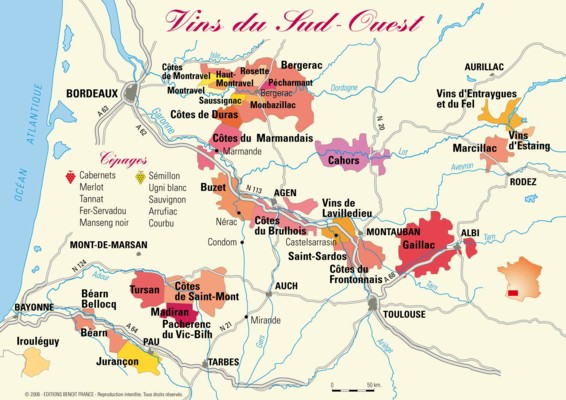
Those of you that follow this blog, have read my comments about Reislings from the Alsace region, and some of the Roses that are coming out of Provence. But some very good wines (at great prices) are coming from the lesser known regions of the Sud-Ouest (or Southwest France), which includes over 30 different AOC's.  The Sud-Ouest is the area located between Bordeaux and the Pyrennes Mountaines. Some of my favorite wines come from Jurançon, Cahors, Madiran, Irouléguy. Additionally the Loire, and Alsace don't seem to get the same attention that the better know regions of France get. Some of the finest examples of Sauvignon Blanc, Chenin Blanc and Cabernet Franc come from the Loire.

Outside of Champagne, traditional sparkling wines are called Crémant. They may or may not be made with traditional grapes, and can be very interesting variations from traditional Champagne. There are some other areas within France that do not carry the Crémant name. These areas typically make both a still and sparkling version of wine, so just go by the AOC name.

This week I conducted a wine tasting of "other French wines". The idea was to move away from the mainstream grapes and regions, and try something different....and to keep the bottle price under $20 (usually difficult for French wines). I served six wines, from some of the regions mentioned above.

The first wine was a sparkling wine: Vincent Raimbault NV Brut Vouvray. This wine comes from the Loire (Touraine district) and is made from 100% Chenin Blanc. Made in the traditional method, this straw colored wine, was bright, clean and has refreshing acidity. Aromas of lemon, grapefruit and flowers.

Muscadet
The second wine was a white wine from the Loire (the western most district of Nantais), made with the Muscadet grape (also known as Melon de Bourgogne): Pepiere 2010 Muscadet Sevre et Maine. I really liked this wine. Nice acidity, dry, a slight yeastiness due to sur lie aging. The classic wine match for Muscadet is seafood (in particular shellfish), and it worked well with the numerous shrimp dishes at the tasting, but I'd sure like to try it with some oysters!

Next was a Rosé from the Rhone region of Tavel: Mordoree 2011 Cotes du Rhone Rose La Dame Rousse. This full bodied, dry Rose was 40% Grenache, 20% Syrah, 15% Cinsault (and the rest Carignan and Mourvedre). Lots of strawberry and cherry, and savory, spice character, with a certain amount of earthiness.The finish was a bit bitter, and turned off some of the tasters, but others loved it.

The first red wine of the tasting was the Chateau du Cedre 2007 Cahors. Cahors is located in South West France just north of Toulouse. This is an ancient Roman wine producing region with evidence of vines being planted as early as 50 BC. The Cahors AOC produces red wines made with the Malbec grape (known locally as Cot or Auxerrois). Yes, Malbec was growing in France before it made a name for itself in Argentina. I would put this wine somewhere between a Cabernet Sauvignon and a Merlot. Nice plum, cherry, and cocoa aromas, and moderate tannins.

Tannat
The second red wine was the Labranche Laffont 2005 Madiran. Madiran is a small appellation, only 3,200 acres of vineyard in total, but it makes big red wines from the Tannat grape. This was a deeply colored wine with dark berry flavors and moderate tannin. The seven years of age help mellow this wine, and presented a very smooth drinking wine. Lots of positive comments about this wine, and was one of the nights' favorites.

The last red wine was very young, and required pouring through an aerator. The wine was Bernard Baudry 2010 Chinon Les Grezeaux. Chinon is the commune, in the Touraine district of the Loire, for Cabernet Franc, and an excellent value at only $22.  The wine was bottled un-fined and un-filtered after spending 12 months in neutral oak (but did have a definite oak presence on the nose). It was full-bodied and probably should be held another 5 years before opening.

So, the next time you are talking French wine, remember that not all good wines cost $60 to $3,000. Sure they are great wines, but you can also find some very good (and different) wines from some of the lesser known regions of France. Continue to explore and try...there are great finds out there!

Buscador Wines

I never know where the next wine blog subject is going to come from. Sometimes, an event during the week sparks and idea, and other times it is questions from followers of this blog. I am always searching for ideas and subjects. This week, the "searcher" came to me, in the form of Buscador Wine. What? You haven't heard of them? Well, that's no surprise, as they only make about 400 cases total. But, if you are like me, you are always looking for one of those "up and coming" winemakers. The ones you can say, "I knew them way back when....".

Matt & Stephanie
I was at the Lake Arrowhead Country Club at the outdoor pub, and they happened to be having a wine tasting. Behind the table were Matt Kowalczyk and his wife Stephanie. They had driven up that day from Santa Ynez, and were heading back that night. After talking a bit, I learned that they were the owners and winemaker for Buscador Wines (Spanish for a person dedicated to seeking out new experiences...a searcher).

Matt and Stephanie are outgoing and friendly. As I talked with them, I learned that we had numerous winemaker friends and contacts in common. Their path to winemaking was interesting. After spending time in Switzerland, France, Spain and New Zealand, Matt ended up in the Central Coast, and has been making wine for the past seven years along side winemaker Mike Brown at Kalyra Winery (remember the movie Sideways?). Stephanie is a Biologist, who spent time working in New Zealand, at Cloudy Bay (home of the world renowned Sauvignon Blanc).

At the Buscador tasting table, they were offering five wines. The first wine was the 2011 Sauvignon Blanc. On my first sip it reassured my belief that the best Sauvignon Blancs in California, are coming from the Santa Ynez region. Good, crisp acidity with citrus and herbal aromas. The second wine was the 2009 Chardonnay. All barrel fermented with a slight bit of oak on the nose, and that yeasty character you get from sur lie aging.

Matt Kowalczyk
Next we moved on to the red wines. First up was the Buscador 2010 Pinot Noir. 100% of the grapes came from the Rancho Camp Alamos vineyards in Los Alamos. This didn't taste like your typical California Pinot Noir. It was much more Burgundian in flavor and aroma. Only one barrel (or about 20 cases) were made of this wine. I picked up a few bottles to store away for a few years (along with an allocation of Sauvignon Blanc). While it is very pleasant now, I think three to five years of aging will make for a beautiful wine. The second red was the 2008 Petite Sirah. This is one of those rare 100% Petite Sirahs. All the grapes were sourced from the Solana Farms Vineyard on the warmer east side of Paso Robles. Matt was really proud of this wine, and it was obvious that this is the style of wine he drinks himself. The last wine at the tasting was the 2009 WaveSlider, the only blend in the mix. The grapes were organically grown, and a mix of 65% Syrah and 35% Petite Sirah. Very Southern Rhone in style.

What I found amazing was the price points. Buscador wines range from only $14.50 to $32.00 (and up to 30% off that if you are one of their wine club members). Speaking of the wine club, in talking with Matt, he tells me that membership in their wine club is free. Right now the wine club is so small, you will even get a call from Matt himself asking you which wines you would like to purchase, and he'll create the shipment mix you want. The wine club may be the only way to get some of his wines too. His last vintage of Malbec is already gone, and he is talking about trying some Roses, which I'm sure will disappear just as quickly. With such small production, and growing acknowledgement of their quality wines, now is the time to get in on the "ground floor" with Buscador Wines.

For more information on Buscador wines, check out their website at: www.buscadorwine.com
or, you can also follow them on Facebook .