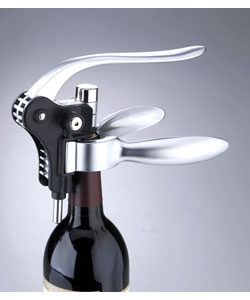
It’s an age old question…to paraphrase Mr. Miyagi, in Karate
Kid, should you leave the “wax on, or wax off” when opening your bottle of
wine.
In the past, most bottles had a simple capsule or protective
sleeve, often called a foil. Now, more and more wineries are dipping their
bottle necks in wax. So, how do you get
the cork out? More on that in a minute.
Why is there even a capsule over the cork to begin with?

Back in the day, wine bottles were typically protected with
a lead capsule over the neck of the bottle. The purpose was to protect the cork
from being chewed on by rats and mice that often inhabited the wine cellars.
The capsule also prevented a potentially leaky cork from dripping on the
ground, and inviting insects into the cellar. Lead was used, simply because it
was easily malleable. You might note that traditional Sommelier service
includes a heavy wiping of the bottle pre and post cork removal, in a throwback
to the early days of cleaning off as much residue as possible. Research
eventually pointed out that lead was toxic, even in trace amounts. By the 1990’s
the lead capsules were replaced with tin, aluminum and shrink-wrapped plastic.
Now, some wineries don’t even use a capsule, and many have switched to sealing
the cork with wax (either with a wax disk, or hand-dipped in sealing wax). Due
to cleaner cellaring practices, the need for a capsule mainly serves as a
decorative article, and a throwback to old traditions.

Just like a screw cap versus a natural cork….in wine,
tradition is part of the romance. To me, a bottle without a capsule feels
cheap, or unfinished. I know, it is more of a perception than it is a reality.
I like the traditions of wine: cutting off the capsule, screwing in the
corkscrew and hearing the pop. Is it just me? I don’t think so.
You will find that some bottles have a paper strip running
across the cork, then that is sealed below the capsule. This is basically an
assurance of authenticity. The idea being that the capsule and paper both would
have to be unbroken, to guarantee that the wine inside had not been tampered
with.
Some of the newer capsules, particularly shrink-wrap
plastic, are more irritating than foil. I use a waiter’s helper corkscrew, which
has a serrated knife. While it works great with foil, it seems to always hang
up on plastic, and tear. And, if you use a foilcutter accessory, they often don’t
cut through the plastic. Many plastic capsules now come with a “pull tab”, but
that just feels cheap to me.
 |
| Foil cutter |
In the past, I would have used a foilcutter, and removed
just the top section of the capsule. Now, I remove the entire capsule with a
vertical cut, the length of the capsule. I then peel off the capsule in one
piece. This allows you to inspect the capsule. Why? Mold and staining on the
inside of the capsule might be an indication of a problem. Staining can
indicate leaks, as can mold. But, with mold, remember that corks are
semi-porous. A moldy smell in your wine is probably not desirable. Proceed with
caution from here. Examine the cork and the wine carefully. Wipe the bottle and
cork with a clean cloth, room the cork, examine, then sip the wine, looking for
any issues.
Now, back to the original question, “how to remove wax from
a wine bottle?” Sealing wax can make a real mess.
There are really only two options: 1) chip away at the wax;
or 2) just drill right in and pull the cork out with the wax still on.
I find that chipping away at the wax is messy, and frankly,
more effort than is needed. Not only is it time consuming, but your bottle will
look like a mess in the end. Remember that wine service is traditional and
romantic. Wax flakes all over the table, and chipped bottles kind of take away
from that. The wax will not peel away from the bottle, as you might anticipate.

The best way to remove a wax capsule is not to remove it at
all. Simply angle your corkscrew into the top of the wax, so that the tip of
your worm/auger is imbedded into the wax. Next, slowly twist the auger in, as
you gradually bring your corkscrew to an upright position. Next, grip the teeth
of our corkscrew onto the outer rim of the wax capsule (you may need to grip
the teeth, to keep them in place), then pull the cork out along with the wax. Some
people prefer to only partially pull the cork out, then chip away some of the
wax, before removing the cork all the way. I just find this to create more of a
mess.
 |
| Pulltex Waiter's Helper |
I should point out that this extraction method requires a
waiter’s helper type corkscrew. Many easy pull type corkscrews just can’t
handle the wax. My corkscrew is a Pulltex. I have had it for at least eight
years, and it continues to be my “go to” corkscrew. Easy to carry, easy to operate, and not terribly expensive.
There you have it, an easy way to remove any capsule. Enjoy
the romance and nostalgia that opening a wine bottle offers.