2014 Family Winemakers Follow up


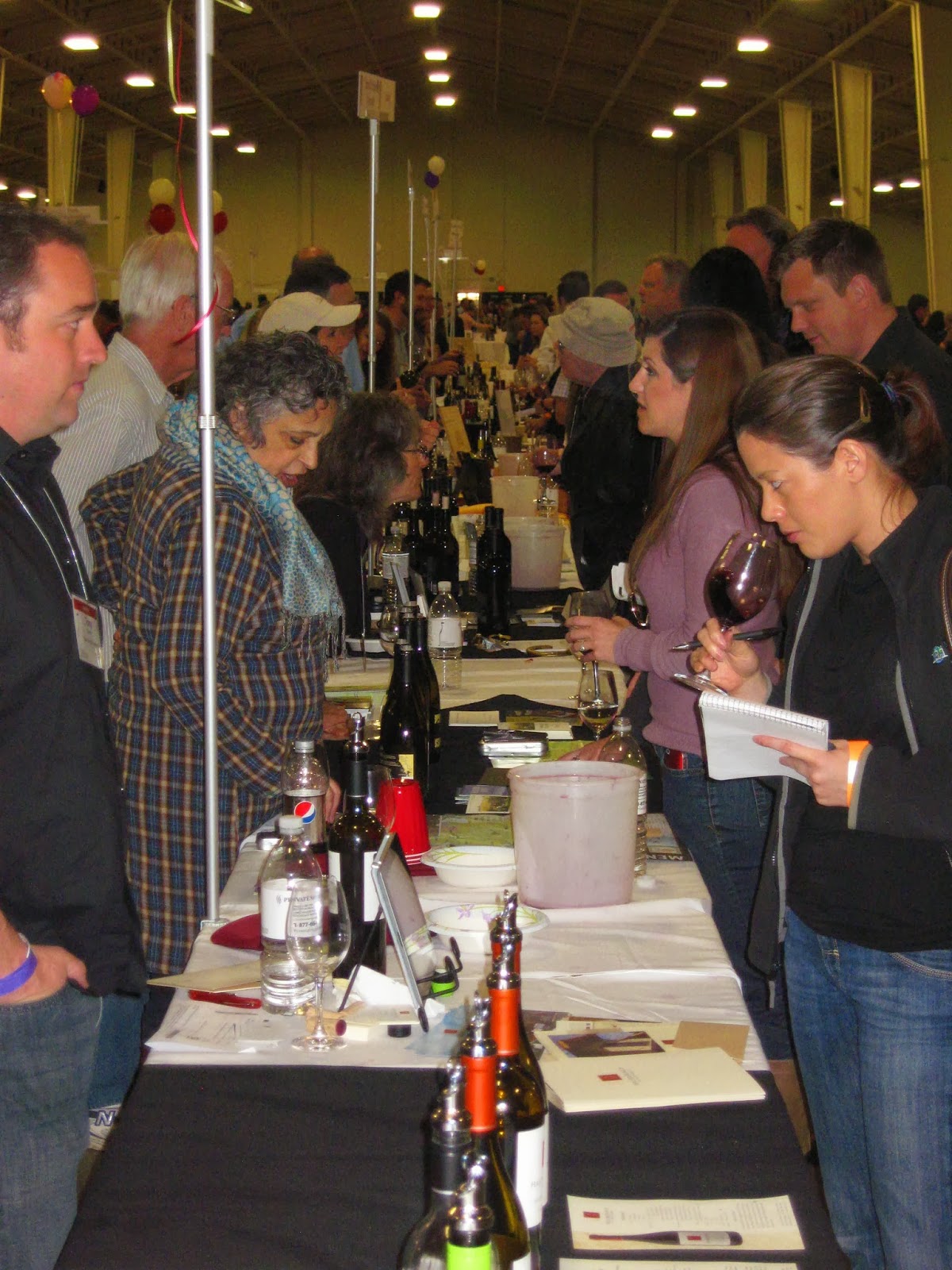
On Sunday, March 9 2014, I had the opportunity to attend the FamilyWinemakers of California event at the Pasadena Convention center. This year, there were 158 wineries pouring some of their best wines. The doors opened at 1:00 for trade and media attendees, then opened at 3:30 for the general public. Most wineries continued to pour wine right up to closing time at 6:00. During my five hours walking the aisles, I was able to taste over 50 wines, met with numerous winemakers and owners, and even caught up with one of my Sommelier students, who was just hired as a Somm for a yet unopened restaurant in Los Angeles.

As in prior years, I had received a list of all the wineries that would be in attendance. I put most of my attention on the Central Coast, and wineries that I had either not heard of, or had not visited. I also focused on Zinfandels this year, in particular old vine Zins from the Sierra Foothills.

Le Belge Chocolatiers
The doors opened a little before 1:00, and we picked up our tasting glass. The convention hall was set up with long rows of wine tasting tables. Above each table was a sign, indicating the winery.  Along the outside edges of the hallway were water stations, and large platters of cheese and crackers. The south wall had a large display of fine chocolates. The back wall was set up with the iSip (or VIP) tasting area.

Dawn Wilson, Martian Ranch & Vineyard
We walked the rows of wine tasting tables, to get the “lay of the land”, and see who we knew. We stopped by Ampelos Cellars and talked briefly with Rebecca and Peter Work). I have known these winemakers for a long time, and have always enjoyed their wines. This time we only tasted their Rose of Syrah, and I am convinced, they make one of the finest roses in California. All their wines are biodynamically produced. Along the same lines, one of my new favorites is Martian Ranch & Vineyard. Nan Helgeland, the owner, and her wine club manager Dawn Wilson, both spent a lot of time filling me in on some activity at their property. Craig and Mike (the two winemakers) have moved on to another property, but their new winemaker, Graham Tatomer, stepped right in, and things are looking very good for this up and comer. They were pouring their 2013 Rose of Syrah which had just been bottled the prior week. Only 437 cases were produced, and already 25% of the total production has been sold. Keep an eye on Martian Ranch & Vineyard (and taste their wines too).

Some of the "picks" of the day:

Janell Dusi
I tasted a lot of Zinfandels during the day, but there were some standout wineries that you may want to check out. The old vine Zins at Sobon Estate were very jammy. The 2011 Rocky Top Zin is produced from 85 year old vines, and had a deep dark berry nose and taste. For those that like fruit, this is one to try. I am more of a lighter style Zin person, and like a bit of spice, and lower alcohol levels. My favorite Zinfandel of the day (and I went back for a second pour) was J. Dusi from Paso Robles. The 2011 Dante Dusi Vineyard Zinfandel was my pick of the day.

One of the surprise finds was a Pinot Noir from a Paso Robles winery.  Derby Wine Estates has vineyards in both Paso Robles and some coastal vineyards around San Simeon. Their 2010  Coastal Vineyard Pinot Noir had the crisp acidity you expect from a cooler growing region, and had an almost Burgudian quality to it. On top of that, Ray Derby is just one of those guys that you like talking to. Down to earth, and loves what he does.

For those that like to collect wines, and look for a wine that will hold and age, check out The Farm Winery. This is a small production winery, making less than 700 cases a year. They don’t have a wine club, or a tasting room. You can purchase the wine at select wine shops, or through their website. The wine for collectors to look at is the 2010 Cardinale, a blend of Cabernet Sauvignon and Malbec. This wine can hold for another 20 years.

 I enjoyed the 2012 Grassini Family Vineyards Sauvignon Blanc. I must admit, while I hadn’t had this particular Sauvignon Blanc, I have been enjoying fruit from their vineyards for years, as they supply grapes to Dragonette Cellars, and I love their Sauvignon Blanc. So naturally, this wine tastes “familiar”. The Happy Canyon AVA is producing some excellent fruit!

In five hours, I was able to visit 20 wineries. Every winery had wines worth writing about, but I really wanted to focus on the stand outs. I won’t write reviews of them all, but want to give “honorable mention to:  Beaucanon Estate (nice Cabernet Franc), Benovia Winery (2011 La Pommeraie Pinot Noir), Black Sears (2006 Howell Mtn Cabernet Sauvignon). Center of Effort (Pinot Noirs), D’Anbino Vineyard & Cellars (nice people, and an interesting fortified Cabernet Sauvignon, called Portamento),  Field Vineyards (2004 Katarina Cabernet Sauvignon), Frogs Tooth Vineyards (2010 Petit Sirah), ONXWines (2011 CRUX), Venteux Vineyards (2010 Tache le Verre Santa Barbara Syrah), The Price Book, Hiatus Cellars, and Hearst Ranch Winery.

So, check out the wines I mentioned above, and also go the Family Winemakers of California website, to check out all the members. Also watch for their next event, and block out the time to attend. It is well worth the expense!

Does Vintage Matter?


When it comes to your wine purchase, is the vintage Important? You’ve heard the word “vintage” but what does it really mean?

In winemaking, vintage usually refers to the year the grapes were grown. So, if you see a wine with a vintage date of 2004 on it, then you can assume the grapes were grown during the 2004 growing season. Now that makes perfect sense, unless of course you are looking at a wine from the southern hemisphere. Think about it….wines in Australia, for example, have a growing season that runs from about October to April. So what year do you use? The year of harvest is what is on the label. 

Okay, so we have that same bottle of 2004 Cabernet Sauvignon. All the grapes were harvested in 2004…..wait, not so fast! Most countries allow a vintage dated wine to include a portion of wine that is not from the year denoted on the label. Old World wines (European Union) only requires that 85% of the wine be from grapes in the denoted year. Australia and New Zealand follow the European requirements. In the United States, the requirement is also 85%, unless it is a designated AVA (i.e. Napa Valley or Paso Robles), in which case, it is 95%. In Chile and South Africa, the requirement is less stringent, only 75% required for vintage-dated wine. 

So, if you’ve got a bottle of wine and there’s no vintage date (often seen on wine lists as NV – “Non Vintage”), you can assume that the wine was made from grapes of several years’ harvests, or at least, did not meet the minimum requirements. This is a common practice for winemakers seeking a consistent style of wine, often referred to as a “house style”. Champagne is the most common NV wine, as the producer blends many years together, to maintain a certain flavor profile. That is not to say there aren’t any vintage Champagnes, as there are. Wines from the best vintages often sell for much higher prices than those from average vintages. Vintages wines are assumed to improve with further aging in the bottle. This has led to a misperception that any vintage dated wine is of higher quality, and capable of aging. While that would be great to believe, it is simply not true. There are some very poor quality vintage dated wines.

But why should you care about the year? 

If you live in California, you know we have a drought, and it has been an unusually warm winter, which has tricked the grapevines into early bud break. As I write this, the weather has turned to heavy rain, and is accompanied by cold weather, creating a much higher risk of frost damage or damage to the vine. Those little buds are very fragile and subject to damage during pruning if they have popped out of the wood. This would lead to a reduced crop, or possibly a poor crop. If you remember the weather right now, when the 2014 vintage is released, you’ll know why it tastes the way it does.

The importance of vintage, however, is often disputed. There is no doubt that cooler regions do see fluctuations in quality, a warmer growing season can produce riper grapes, while a colder growing season might produce lower sugar levels, and higher acidity. Extremely hot growing season can also produce flabby wines. The best example of where vintage makes a difference is Bordeaux. This growing region can easily be influenced by the weather during the growing season.

There is an argument that due to new winemaking techniques and the use of irrigation (particularly in the New World) has created a more uniform style of wine, that doesn’t vary much from vintage to vintage. Some even argue that there is not difference between vintages on New World wines. I am not one of those believers. If you’ve read this blog for a while, you have read about some of the vertical tastings dinners I have conducted, and there is a difference between vintages (a vertical tasting is a series of wines from the same producer, over a number of different vintages, i.e. 2004, 2005, 2006, and 2007 – which would be a 4-year vertical).

Back to Bordeaux….many wine collectors are concerned about vintage, as the best Bordeaux wines will age for decades in the bottle, and actually improve. These wines can be extremely expensive, and you have to have the patience to hold on to them, as well as cellar them under proper conditions. And, isn’t it nice to know the age of the bottle you have in your cellar? Inexpensive wines are typically meant for early consumption, so vintage is probably not as important. But, even with the inexpensive wines, it might be good to know the vintage. If you had that wine before, and you liked it, you can look for it again. If your wine shop is out of that vintage, and you still have one of the older vintages, try tasting them side by side, and see if you can taste any difference, or does that winery make a “house style” that is the same every year?

The importance of vintage is one about which disagreement can be expected to continue. For me, it does matter, particularly for Old World Wines.

Wine Tasting Opportunity


It’s that time of year again! No, not the end of winter, but the time to start thinking about attending the Family Winemakers of California event.  This year, it will be held in Pasadena, on  March 9th. It is your opportunity to taste some of the best wines in California, and meet the winemakers and owner. There will be about 175 wineries, and around 750 different wines, from Napa, Sonoma, Paso Robles, Santa Ynez, Temecula....well you get the picture.

This will be the 11th tasting of small, family-owned wineries from across California.  The Pasadena Tasting is open to trade and wine media, as well as consumers.  Also featured for the first time will be the iSip Lounge for specially ticketed consumer who want to taste wine retailing for $75 or more.
Last year, I attended the event at the Del Mar Fairgrounds, in San Diego, and tasted about 130 different wines. Note that I said “tasted”, not “drank”…big difference! These events are normally open only to those in the trade, and mainly meant as a buying opportunity for wine shops and restaurants. BUT... this is the 2nd year that they are open it to the public for a few hours.

The past president of the organization, Paul Kronenberg said, “As the region’s largest tasting of California wines, the event gives members of the trade and wine enthusiasts alike the opportunity to taste hundreds of wines coming from California’s small production, family-owned wineries.  It’s a great opportunity to taste and discover exceptional and hard-to-find wines while getting to meet the passion-driven winery owners and winemakers behind it, who are committed to the craft of producing quality wines.”. Kronenberg continued, “The Family Winemakers tasting introduces attendees to California’s small, family-owned wineries, the varietals being produced by California wine growers, and the state’s many rich and diverse wine regions.  With such a vast selection of wines, I am positive that each person who attends will discover a new favorite.”

According to their website, the Family Winemakers of California Association was established in 1991 in response to a need for public policy involvement for the small wine producers of California.  The Association has become a strong force in the wine industry, lobbying for wine producer rights, and has an active membership of over 550 California wineries.  Family Winemakers draws its membership from all the wine producing areas of the state, with the largest concentration coming from Napa and Sonoma Counties.

Doors open for the Trade at 1:00pm, then to the general public at 3:30. The tastings run until 6:00pm. The cost of the event, for the general public, is $70 at the door, but I am going to share a way to get in at a lower cost. If you register before March 8th, you can get in for only $60. Tickets are on sale right now, and can be purchased online at the family winemakers website at the advance ticket prices. This year’s tasting will also offer a new iSip Lounge, only open to consumers.  There will be 25 wineries pouring wines that sell for $75.00 or more at retail.  Limited tickets for this area.  First come first served at $80/person (which includes your general admission). There is also a limited offer for admission during the trade segment plus iSip Lounge Reserve area on Sunday (1:00 on), 100 tickets only, first come first served, $100.

Those of you, who can't make the event, can also look for my recap on this blog site, the week after the event. But, who wants to read about it, when you have the opportunity to attend? If you see me walking around (and most likely tasting and talking) introduce yourself, and say, "hi".