Napa Valley

This week my wine club will be doing a tasting of Napa Valley wines. The challenge was to find quality wines, that represent the growing region, at a price of around $20. While looking through the crates of wine at one of my favorite wine shops, I couldn't help but notice the average price wines from this region. While I was able to find five excellent examples at an average price of $21 (including tax)...the overall average of the wines on the shelf had to have been around $50.  Heck, I have a few bottles of Screaming Eagle that are now retailing for well over $1,000/bottle. This got me thinking: how did Napa get to where it is now?

Most of us can't remember a time when Napa Valley wasn't even a blip on the world radar of wine, but the current status of Napa only goes back to the 1970's. How many of you saw the movie "Bottleshock"? This is a great representation of the 1976 judgement in Paris, where the 1973 Chateau Montelena Chardonnay, and the 1973 Stag's Leap Wine Cellars Cabernet Sauvignon, beat the venerable French.

Napa is a Native American word (from the Wappo Indians) that is roughly translated as "land of plenty". According to A History of Wine in America, by Thomas Pinney, the first vines planted in Napa actually came from the Sonoma Mission, and were planted by George Yount in 1838 (in what is now Yountville). Vines were later planted in what was to become St. Helena. The first commercial winery in Napa Valley is credited to Charles Krug (a Prussian immigrant) in 1861, and by 1889 there were more than 140 wineries in operation, including Schramsberg (1862), Beringer (1876) and Inglenook (1879).

The onset of Prohibition (the Volstead Act) from 1920 to 1933, devastated the wineries of Napa Valley. Those that did survive shipped unfermented juice to home winemakers (home winemaking for personal use was allowed), or produced sacramental wine. Jump ahead to 1943, and the purchase of Charles Krug by Robert Mondavi, for $75,000, and you'll see the beginning of the Napa Valley that was to come. In her book, The House of Mondavi, by Julia Flynn Siler, the Napa of the 1960's is described as, "prunes were still the primary crop, and St. Helena's schools sometimes closed during those years to allow children to help out with harvest. The town's population was just a few thousand people." Robert Mondavi was one of the forces behind quality dry wine (prior to this most wines from Napa were jug wine, and fairly sweet, when he broke away from the family winery of Charles Krug, and opened Mondavi Estate. Thus began the "boutique" winery, and the perfection of what Napa could offer. Today, there are more than 400 wineries in Napa.

Map Courtesy of Napa Valley Vintners
The Napa Valley is an American Viticultural Area (AVA) that is only 30 miles from north to south, and 5 miles wide. Within the Napa Valley AVA or appellation there are 15 sub-appellations, including: Atlas Peak (volcanic soils), Calistoga, Chiles Valley District, Diamond Mountain District, Howell Mountain (tannic wines from the higher altitude), Los Carneros, Mt. Veeder, Oak Knoll District, Oakville (concentrated fruit), Rutherford (distinctive minerality and "Rutherford dust"), St. Helena, Spring Mountain District, Stags Leap District (wines with herbal notes), Yountville, Wild Horse Valley.

They say there is always one wine that gives you that "aha" moment. That point when you say, "I never knew wine could be this good" For me, that started with Napa Valley. My brother-in-law worked for Mondavi, and I worked for Nestle (owner of WineWorld: Beringer, Meridian, Chateau Souverain). I was living in Utah, where good wine was a bit hard to come by. Family visits from California, kept us stocked on good wine. After seven years in Utah, Nestle moved us to San Francisco, and I was only 45 minutes from Napa. My "aha" moment was during my last week with Nestle. I was at the Stanford Court Hotel (Fournou's Oven restaurant) at the top of Nob Hill, at a dinner with our good friends Nick and Karen Burcher. I ordered the most expensive bottle I had ever ordered, a 1978 Heitz Marthas Vineyard Cabernet. The way the wine worked with the smoked prime rib was eye-opening. Since that time, I have experienced many great bottles, and am always seeking more.

This Friday, our wine club will be trying five wines (four from Napa). Check our website (www.ArrowheadWineClub.com) for the feedback on those wines by going to "Jim's Tasting Room". And, please share your "ah ha" moment, by leaving a comment below.

Wine: Old World vs New World

Those of you who have joined me at wine tastings, hear me throw out descriptions that may or may not make sense to you. I often refer to wines as "old world" or "new world", or I might describe a wine as being "old world" in style. So, what exactly do I mean?

"Old world" refers to wines grown in European countries. These countries have long history with wine growing, many going back several hundred, or even thousands of years. The most notable countries would be France, Italy, Spain, Germany, and Portugal. There are many others that are considered old world, but we just don't see too much of their wine in the United States. some of the less known are: Austria, Romania, Switzerland, Greece, Hungary, plus many more.


"New world" includes all the other areas. The most obvious would be: The United States, Australia, Chile, Argentina, New Zealand, and Canada. The less obvious "new world" regions would be South Africa and Mexico. The reason I say "less obvious" is that it seems that wine has been in these areas for a long time. In fact, South Africa has been producing wine since the 1600's and Mexico saw the introduction of wine in the 1500's with the arrival of Spanish missionaries.

Geography aside, there are differences in styles of wine. The following is a generalization, as each region makes its' own style, and there are regulations that may or may not determine the style of the final product. Old world wines tend to emphasize terrior, while new world wines tend to emphasize the grape variety. Have I lost you yet? Terrior is a French word that really has no translation in English. The best description is that it means a sense of place. This includes the soil, climate, sun exposure (topography). The goal of old world winemakers is to not meddle with the wine, and let it express the place that it came from. Probably the best example of this is in Burgundy, France, or Mosel, Germany. Both of these areas have long traditions of growing vines in the most proven locations, with time tested growing techniques. Have you ever noticed that Pinot Noir from Burgundy or Riesling from Germany tastes different than the same grapes grown in California? These are the same grape varieties (other than clonal differences) but they just taste different. I find the Pinot Noirs from Burgundy to be more earthy than their new world counterparts that are much more fruity. Many people will argue that terrior is a myth, but try wines from neighboring vineyards, and you will taste a difference. Again, a generalization, but I find old world wines to be lower in alcohol, smoother (subtle) and in most cases, more complex than new world wines. new world wines tend to be bolder, and fruit driven. To me, this means better for pairing with food. Think about it, earthy complex flavors work with earthy, complex foods, but high alcohol and high fruit don't work with a lot of foods. New world wines might also be more manipulated (irrigation in the vineyards, natural compounds added to the wine to adjust acidity, sugar, tannins, etc). The goal is to emphasize the fruits' potential.

The last difference between old world and new world has to do with labelling. Old world wines typically are known by their regional name (ie Bordeaux, Rioja, or Chianti), whereas new world wines are known by variety (ie Cabernet Sauvignon, or Chardonnay). If you are buying old world wines, and you really like Chardonnay, then you would need to know that Chablis, or Pouilly Fuisse are both made with Chardonnay.

Here's a challenge...buy some old world wines, and new world wines. Do your research to make sure they are the same grape variety, and try them side by side. See if you notice the difference.

Wine Storage

You've just found this great wine, and think it would be the perfect bottle (or case) to set aside. You figure, "this wine has great staying power, and will been even better a few years down the road". So where do you store it? In the closet? On that wine rack on your kitchen counter? Or, do you have a cellar? I would venture to guess that most of you do not have cellars, so there are steps you can take, to make sure those bottles you set aside do live up to your expectations.


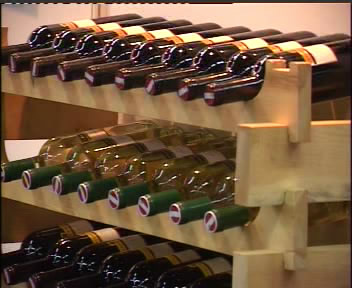
When I started collecting wine in the 80's my wine storage consisted of a plastic milk crate located in the basement of our house. I have no idea what the temperature was, but the wine held up pretty well. Later on, I expanded to a nice wooden wine display rack, that I located in my living room (this way I could show off some of my collection)....but the wine didn't seem to hold up very well. I ended up putting my best bottles in the closet in the center of the house (they did much better there). I learned the basics of wine storage by trial and error. Let me save you some steps, as well as help you save your wine. There are five things you should keep in mind, when storing your wine: 1) Temperature; 2) Humidity; 3) Light; 4) Vibration; and 5) Cleanliness.

Temperature - The most important thing is consistency of temperature. Think about it, heat makes liquids expand, and cold causes them to contract. If your temperature goes up and down, there is a danger of the cork (or any other seal type) failing. This would lead to oxygen entering the bottle, and your wine oxidizing.  There are ideal temperatures to store wine at. Whites are usually stored at lower temps than reds, so your storage range should be somewhere between 45 and 64 degrees. The ideal range is a little tighter: between 50 and 56 degrees (these are obviously fahrenheit). Keep in mind that the higher the temperature, the faster the maturation, and keep the temperature consistent. My cellar has one temperature, so I store my white wines on the lower racks and the reds higher up.

Humidity - with traditional sealing (corks) humidity is very important. Think about it...cork is bark from the cork tree, so the humidity of your storage area will affect the integrity of your seal. If it is dry, the cork could dry out, shrink, and expose your wine to air, and possibly leak wine out of the bottle. Too much humidity can also be a problem, causing mold to develop. Ideally, your humidity should be around 75% to 80%.
Light - have you noticed that most wine bottles are green, or brown? Not too many clear bottles out there. Reason...wine is photosensitive. In other words, it reacts to light. White wines will darken, and red wines will fade. If you save wine labels, the light will also fade your labels. Store your bottles in a dark location.

Vibration - wine is a living organism. Great efforts are made to treat the wine gently during the winemaking process, and the maturing process should be the same. Over time, the wine settles out. Those bottled without filtering will have sediment that needs to settle down. If you are constantly turning, and shaking, you may upset the desired physical changes. I store my bottles, label up, and with wine tags on the neck, so I don't have to pull bottles in and out to determine what is in the rack.

Cleanliness - store a bag of garlic next to your wine, and tell me what happens. How did that garlic smell get into everything? Trust me here, keep your wine in a clean, odor free, well ventilated area.

Besides storing your bottles, the only other thing I would recommend is keeping records of the wines you have stored. There are wine cellaring software programs you can buy, but I just keep all mine on an Excel spreadsheet. I keep track of the name, style of wine, vintage, purchase price, estimated "drink by" dates (based on my estimates, and write-ups in trade magazines) and my tasting notes.

So where do you store you wines?  Is it time to move them to a better location?