Showing posts with label Sommelier. Show all posts

Wine Education - Back to Basics

Those of you who follow this blog, know that I am a Sommelier. What you may not know is that I am also a certified wine educator. For the last couple weeks, I have been teaching basic level (or beginner level) sommelier certification with the International Sommelier Guild (ISG). As I teach each of these six hour classes, over a period of four weeks, it reminded me of the need to learn the basics of wine, in order to understand the more complex world of wine.

In level I of the ISG course of study, we touch on a number of subjects. The word "touch" really is the important word in that sentence. I tell my students that learning about wine is like playing with one of those Russian Nesting Dolls. You know, the dolls that you open up, and there is another doll inside, and another, and possibly another. Well learning about wine is like that, because the outer layer is the general information that needs to be learned, before you can move ahead, and dig deeper, and get more refined in your education.

Some of the wine topics we cover are history of wine, and how it affected wine laws, regional names and growing regions, as well as disease and pest influences. We cover viticulture (wine growing), wine life cycles, viniculture (wine making for red, white, rose, fortified and sparkling), service technique, food and wine pairing, cellaring and storage. But the most important aspect of level I education is tasting technique, and knowing the most prominent wine varieties.

Pinot Noir
The wine varieties we spend time on are: Chardonnay, Sauvignon Blanc, Riesling, Gewurztraminer, Chenin Blanc, Pinot Gris, Muscat, Pinot Noir, Cabernet Sauvignon, Grenache, Gamay, Merlot, Zinfandel, Cabernet Franc, Syrah, Grenache, Sangiovese, Tempranillo, Nebbiolo, and different styles of Sherry, Fortified wines, and Sparkling wines. Not only do we taste different styles of all these wines, we spend time understanding the grape, their growing regions, grape growing issues (preferred climate, soil, diseases, yields), wine making techniques, and of course typical aromas and flavors.

Why is this even important? Obviously, knowing the aromas, flavors and aging ability will help determine what you purchase. Knowing all the other elements helps in understanding the differences between vintages, and the differences between the "house style" of each winery. For example, if you know that Cabernet Sauvignon is a late budding and late ripening variety, then you would know that a late season rain or hail storm, could really hurt the vintage, since the Cabernet hasn't been harvested yet (but the earlier ripening Merlot might already have been picked), meaning your Bordeaux might be more Merlot influenced versus Cabernet. Knowing this particular example, also helps us to understand why Bordeaux is usually a blend, versus a single variety.

While a good amount of the education is spent on the individual grape varieties, an equal amount of time is spent tasting the wines, and writing down a systematic series of notes about the wine. We start with our appearance observations, then move to the nose, then palate, and finally our conclusions. Each time we taste a wine, we evaluate it in the same order. Our notes act as a record of what the wine was like at the time of tasting. Later on, we can try the same wine, and see how our notes have changed, allowing us to see the progression of the wine. These notes also allow us to share our experience with others in a way that is understandable and consistent. They force us to evaluate those senses that we commonly overlook (smell and taste)

My goal as a wine educator (and your blog writer) is to help you understand wine, but most of all, enjoy what is in your glass, and appreciate all that it took to get there. If you have ever wanted to learn more, I would encourage you to seek out an ISG educational course in your area, and take at least Level I and II. I guarantee that you will walk away with a new appreciation. Should you decide (like I did) that there is so much more to learn, you'll load yourself up with books, and maybe even go for your full Sommelier certification.

What is a Sommelier?

Tasting with the Internatonal Sommelier Guild
You've heard me mention the word "Sommelier" numerous times, heck, that's the name of this wine blog, But, what is a Sommelier, and what should you expect from one?

It is thought that the word "Sommelier" (pronounced as Som-al-yay) comes from the old French word sommerier, meaning provisions officer. Today, the word has come to define a position on the field of hospitality, having to do with wine, wine service, along with wine inventory and purchase. Many fine restaurants employ a Sommelier to manage all aspects of their beverage service (including spirits, beer, coffee, water and tea).

When you go to a restaurant, how can you use the Sommelier? First, don't be afraid to ask for help in your wine selection. If you have a good Sommelier, his/her goal should be to enhance your dining experience.

When you look at the menu, what do you look at first? Price? Food? Wine list? If you are like me, I look at the wine list, then figure out what dinner item will go best with the wine I want to try, but I'm sure most of you look at the menu, then try to figure out which wine to go with it. This gets particularly tough when you have a group, and everyone is ordering something different. In these different cases, let your Sommelier know what your budget is. This embarrassing moment can be avoided, by simply pointing to the wine list, and telling your Sommelier that you'd like something "in this price range". Share your knowledge of wine. If you can describe the styles you like, that will be helpful, but if you really don't know, tell your Sommelier what wines you do like.

The job of the Sommelier is to know and understand different wine styles, wine regions, food pairing, and wine service. Think if a Sommelier as your private wine expert for the evening.

There a numerous organizations and associations that certify Sommeliers. Probably the best known are the Court of Master Sommeliers and the International Sommelier Guild (ISG). The certification is an extended (and ongoing) educational process, that includes multiple choice, and essay exams, as well as service demonstrations, and of course blind tastings and judged tasting notes. For a recap of my experience, check out one of my original blog articles by clicking here.

I am a certified Sommelier, earning my SGD (Sommelier Guild Diploma) with the ISG, and up to level III with the WSET (Wine & Spirits Education Trust). In my case, I do not work in a restaurant. I choose to conduct wine tastings, wine tours, and educate. I started this blog to answer your questions and educate. Many of you have taken me up on that offer, and have sent me private e-mails for food pairings, and wine suggestions. When you do, those questions give me ideas for my blogs. So, keep them coming.

It's Rosé, not White Zinfandel

Over the weekend, I met with a client who wants me to conduct a wine tasting party. When we got to discussing which wines to purchase, she said she would buy her own. I gave her some guidance on white and red wines, then I said she might want to include a rosé. She said, "Like white Zinfandel?". I hear this a lot. It is unfortunate that most people think of rosé as white Zinfandel, because they are missing out on some great, versatile wines. I find myself serving more and more rosé wines, and there is a growing rediscovery of these great wines..

To make rosé, the winemaker needs red grapes. As you are probably aware, most juice from red grapes is clear (there are a few exceptions). The wine from red grapes gets its' color from contact with the skins during the maceration process. The amount of time and temperature, as well as the pigment in the skins of the grapes, will eventually determine the color of the finished wine. To make rosé there are actually a few different approaches: blending; saignée; and skin contact. Blending is probably the least likely approach you'll see. In this process a little red wine is mixed into a white wine. The only wine region that admits to doing this is Champagne, for their pink sparklers. A more common method is known as saignée. In this process some of the juice is bled off of a tank of red wine. The remaining red wine is now more concentrated, with more color and  intensity. The amount that is bled off, is put into it's own vessel, and fermented to the desired alcohol and residual sugar levels. In the last method, the red grapes macerate with the skins for a short period of time. This is usually just enough to extract the desired color from the skins. The juice is then separated from the skins, and proceeds just like a white wine.

You may also hear the terms "blush" versus rosé. While these are probably considered interchangeable, I would suggest that blush wines have a bit more residual sugar and tend to be lighter in color. When I think of  blush, this is when I think of white Zinfandel. When I think of rosé however, I think of Southern France. Some of my favorite rosé wines are from Tavel and Bandol. These wines are made from Grenache/Cinsaut and Mourvedre, respectively. These wines can be expensive, and sometimes hard to find, but if you see it at your local wine store, buy a bottle and give it a try. These wines are not meant for storage, but are ready to enjoy within the year they are released. My favorite Bandol is Domaine Tempier.

Lately, I have been finding some very nice rosés coming out of the California Central Coast. Some of my favorites: Dragonette Cellars Rosé (Grenache, Syrah, Mourvedre), Ampelos Rosé (Syrah), Foley Rosé (Pinot Blanc), and  Mitchella Reluctant Rosé.

Back to the beginning...if you like white Zinfandel, then drink it. Sutter Home and Beringer make nice satisfying and refreshing wines. I find these as good "entry level" wines, for those who are starting to try wine. Heck, I started on Annie Green Springs, Boone's Farm and Asti Spumante (yes, I'll admit it,,, but it was over 30 years ago). As the weather warms up, and summer approaches, keep these great wines in mind (and on ice).

Buttery Chardonnay - Malolactic Fermentation

Last week, we did a wine tasting of Napa Valley wines. I had two white wines: Sauvignon Blanc and Chardonnay. Talk about two extremes...the Sauvignon Blanc was crisp with acidity, and the Chardonnay was full and buttery. I referred to this as a "California style" Chardonnay. That's probably an unfair moniker, as there are all types of Chardonnay styles in California, but I would argue that this is the style that was very popular in California. It was rich, buttery, and oaky. It is a style that some people love and some people hate. Even with our group of tasters, I'd say it was 50/50 on like and dislike. I spent a short amount of time explaining how this style is made, and thought it might need some further explanation here.

First, Chardonnay is a fairly neutral grape variety. In blind tastings, it is hard to determine, as it can be manipulated into so many different forms just by the use oak versus stainless steel while fermenting. Oak can add all types of flavors depending on whether it is American Oak (sweet vanilla and coconut flavors - can be fairly pronounced) or French Oak (more subtle than American). Even the toast level can add smoke, cinnamon and clove aromas.

The buttery aromas are created by a process known as Malolactic Fermentation (MLF). To understand this process, we need a little understanding of the grape. All wines are acidic, and within the grapes there are numerous acids present. Among those acids are Tartaric Acid, Malic Acid, Citric Acid, Acetic Acid, Butyric Acid, Lactic Acid, Succinic Acid, Ascorbic Acid, and Sorbic Acid. Of these, Tartaric acid is the most prevalent, but it is the Malic and Lactic that this discussion will concentrate on. Malic Acid derives its' name from the Latin for "apple" (or malum), while Lactic Acid derives its' name from the Latin for "milk" (or lactis). To visualize the differences, think green apple acidity versus yogurt acidity.

Malolatic Fermentation (MLF) is not actually a fermentation, although before it was understood, it probably appeared as such. MLF often occurs after the grapes have completed their fermentation. It is a process where Malic Acid is converted to Lactic Acid. During this process, carbon dioxide is also released (simulating fermentation). MLF will occur naturally, but is now controlled by the winemaker. They will add a bacteria to the fermented juice that will start the process. You may be familiar with the bacteria, as it is common in yogurt and cheese. One of the most common is lactobacillus (some others are pediococcus and oenococcus). These bacteria convert the tart Malic Acid to the fuller, less acidic Lactic Acid, increasing the PH level, and adding the butter, or butterscotch aromas (known as diacetyl). The resulting wine is fuller, and has more mouthfeel. The resulting wine is also more stable. The MLF process is almost universal for red wines (sometimes avoided for red wines that are meant to be sold/drunk young, like Dolcetto and Beaujolais), but certain white wines like Chardonnay take to the process well. More acidic white wines will avoid any MLF, as the winemaker wants to retain that tart acidity, and fresh fruit aromas, that would otherwise be smothered with the buttery aromas of MLF.

MLF will be done in different batches so that the winemaker can later blend the wines together, creating the preferred style for the winery. You will often hear of wines with 50% or 30% MLF....this created by blending from different tanks of wine.

There is also some discussion (but no conclusion) that the bacteria used to initiate MLF might produce histamines, which affect certain sensitive people. This may (and I emphasize "may") be a cause of the red wine headaches that some people get.

So, the next time you smell and taste a wine, and pick up those buttery/dairy aromas, remember MLF, and the process to get the wine to this point. Are you a fan of this style of Chardonnay? If so, what are some of your favorite wineries? At our wine tasting, we had the 2009 Trinitas Chardonnay. Some others I have enjoyed are La Crema, and Kistler.

Wine Storage

You've just found this great wine, and think it would be the perfect bottle (or case) to set aside. You figure, "this wine has great staying power, and will been even better a few years down the road". So where do you store it? In the closet? On that wine rack on your kitchen counter? Or, do you have a cellar? I would venture to guess that most of you do not have cellars, so there are steps you can take, to make sure those bottles you set aside do live up to your expectations.


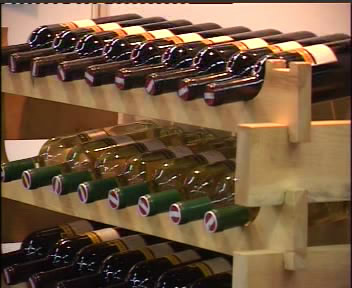
When I started collecting wine in the 80's my wine storage consisted of a plastic milk crate located in the basement of our house. I have no idea what the temperature was, but the wine held up pretty well. Later on, I expanded to a nice wooden wine display rack, that I located in my living room (this way I could show off some of my collection)....but the wine didn't seem to hold up very well. I ended up putting my best bottles in the closet in the center of the house (they did much better there). I learned the basics of wine storage by trial and error. Let me save you some steps, as well as help you save your wine. There are five things you should keep in mind, when storing your wine: 1) Temperature; 2) Humidity; 3) Light; 4) Vibration; and 5) Cleanliness.

Temperature - The most important thing is consistency of temperature. Think about it, heat makes liquids expand, and cold causes them to contract. If your temperature goes up and down, there is a danger of the cork (or any other seal type) failing. This would lead to oxygen entering the bottle, and your wine oxidizing.  There are ideal temperatures to store wine at. Whites are usually stored at lower temps than reds, so your storage range should be somewhere between 45 and 64 degrees. The ideal range is a little tighter: between 50 and 56 degrees (these are obviously fahrenheit). Keep in mind that the higher the temperature, the faster the maturation, and keep the temperature consistent. My cellar has one temperature, so I store my white wines on the lower racks and the reds higher up.

Humidity - with traditional sealing (corks) humidity is very important. Think about it...cork is bark from the cork tree, so the humidity of your storage area will affect the integrity of your seal. If it is dry, the cork could dry out, shrink, and expose your wine to air, and possibly leak wine out of the bottle. Too much humidity can also be a problem, causing mold to develop. Ideally, your humidity should be around 75% to 80%.
Light - have you noticed that most wine bottles are green, or brown? Not too many clear bottles out there. Reason...wine is photosensitive. In other words, it reacts to light. White wines will darken, and red wines will fade. If you save wine labels, the light will also fade your labels. Store your bottles in a dark location.

Vibration - wine is a living organism. Great efforts are made to treat the wine gently during the winemaking process, and the maturing process should be the same. Over time, the wine settles out. Those bottled without filtering will have sediment that needs to settle down. If you are constantly turning, and shaking, you may upset the desired physical changes. I store my bottles, label up, and with wine tags on the neck, so I don't have to pull bottles in and out to determine what is in the rack.

Cleanliness - store a bag of garlic next to your wine, and tell me what happens. How did that garlic smell get into everything? Trust me here, keep your wine in a clean, odor free, well ventilated area.

Besides storing your bottles, the only other thing I would recommend is keeping records of the wines you have stored. There are wine cellaring software programs you can buy, but I just keep all mine on an Excel spreadsheet. I keep track of the name, style of wine, vintage, purchase price, estimated "drink by" dates (based on my estimates, and write-ups in trade magazines) and my tasting notes.

So where do you store you wines?  Is it time to move them to a better location?

Wine: drink now or hold?

One of the most common questions I am asked, as a sommelier, is whether a certain wine is ready to drink now, or should it be stored away for later? Well, the answer will involve going back to my previous articles on tasting. If you are comfortable with the steps in tasting a wine, then you will have a better idea on how well a wine will age. 

First, if you are buying the wine at your local retailer, and have not tasted it, you should know that over 90% of all wines are produced and released, ready to drink. I heard somewhere that the average aging of a wine, purchased at a local retailer, is about 40 minutes (the time to drive home, and open). Another thing to understand is that it is just as easy to age a wine for too long, as it is to age it for too little time.This is where your expertise at tasting will suit you well.


Some general things to keep in mind: 1) expensive wines can usually age better than inexpensive wine; 2) red wines are more likely to improve with age, than white wines (but there are a lot of exceptions); 3) if not stored properly (a subject for another article) aging may actually ruin a nice bottle of wine.

So how do we determine the potential ageability of a wine? There is no definitive answer, but we can make an educated guess, based on our tasting profile, and those handy little vintage charts that are available in many wine magazines and websites. High rated vintages (year that the grapes were harvested) would give an indication of higher potential. When you taste, take note of the acidity, tannins, alcohol, and residual sugar levels. On those nose, take note of the primary fruit aromas, versus the more complex aromas of a developing bouquet.

In general, when you smell a wine, you may get a lot of fruit (primary aromas) on the nose. This is an indication of youth. As you move into more "non fruit" related aromas (called secondary aromas) these are signs of aging. Primary fruit, with no secondary aromas, might mean there is aging potential...but not always. As wines age, they gain complexity, while losing fruitiness. Most white wines are made to preserve and emphasize fruit aromas (and some reds like Beaujolais Nouveau for example) are meant to be drunk now. We need to look at some other factors, other than just smell. Tannins, acid and alcohol all have a role in determining a wines' future potential. All three of these components act as preservatives that prevent a wine from oxidizing. As wines age, chemical processes within the wine cause the tannins to soften and actually settle out as sediment. The trick with tannins is how they taste. I find that many tannins taste "green" to me, and I find that green tannins, stay green even with aging. Look for ripe phenolics in your tannins.  High alcohol in wine, acts to prevent the processes associated with oxidation (the main reason wines were fortified for long boat journeys back in the early days of wine export). Acid, like tannins and alcohol, is a preservative, but acts to balance the fruit component in the wine. Wines high in acid but with a strong core of fruit are perfect wines for aging. Over time, the acid will act to maintain the structure of the wine allowing the wine to age more gracefully. Just remember that acid does not change in the same way that tannin does. The wine will need more fruit to balance the higher acidity. Residual sugar also helps to balance acidity. This last point explains why white wines, like German Rieslings, and dessert wines (Sauterne and Tokaji, for example), age so well.
Oxidized Wine

One other thing to keep in mind is the size, or format, of the wine bottle. The standard wine bottle is 750ml. Each bottle will have a little head space of oxygen (known as ullage). Since oxygen is the greatest threat to aging, the amount of ullage in larger formats (1.5l or higher) versus regular sized bottles means less oxygen exposure. Larger formats age better.

Remember, that when determining whether or not a wine will improve with age, trust your tasting notes. Talk with your local retailer, or review the write ups in your favorite wine magazine to find out which wines have potential, then buy more than one bottle.  Store the wine properly and taste a bottle every so often. Make tasting notes on how the wine is developing and changing over time, and enjoy the journey!

Are you a Wine Snob?

Let's be frank about it, when you're at a restaurant, or a friends house, and the topic turns to what wine to have that evening, do you intimidate others with your knowledge? Do you turn your nose up at the suggestion of Charles Shaw Cabernet with your meal? Or, are you like Myles in the movie Sideways, who won't drink any f*@%ing Merlot? Come on, admit it. Could you be (gasp) a "wine snob"?

What is the definition of a "wine snob"? The dictionary says a "snob" is, "somebody who looks down on others and considers their own knowledge, or position, to be superior". This might be a good thing when it comes to wine, as a wine snob might know enough about wine that they can pick an excellent bottle off a wine list, without paying a fortune for it. And, that pick might just be the best pairing you ever had. Then again, that same wine snob may make you feel insecure about your own decision, and even ridicule your choice. I think there is a fine line between being a wine snob, and a wine enthusiast (or even a "wine geek").

I think we should all try to be "wine enthusiasts". To me an enthusiast is willing to try new wines, and is always exploring new pairings, new varietals, and continuing to learn. An enthusiast never belittles other peoples' wine choices, tastes, or opinions. An enthusiast likes to learn about wine, and is eager to share that knowledge with others.

Recent reports show that individuals aged 21 to 34, are increasingly pursuing wine for a variety of reasons. “They equate it with sophistication, it allows them a means to connect with friends, and they see it as a more healthful alternative to other alcoholic beverages,” This age group tends to purchase more imported wines than baby boomers. We are in the age of the enthusiast!

My hope is that we remain enthusiasts, and never turn into snobs. Let's leave the snobs to their own self-image, and simply enjoy the wine we are drinking. After all, Psalm 104: 14-15 says, "He causeth the grass to grow for the cattle, and plants for the service of man: that he may bring forth food out of the earth and wine that maketh glad the heart of man, and oil to make his face to shine, and bread which strengtheneth man's heart."

Okay...let the comments begin. Are you a snob, or an enthusiast?

Thanksgiving Wine Pairing Ideas

With Thanksgiving only a couple days away, I have been getting a lot of questions about what wines to pair with the Thanksgiving dinner. I've got to say that this is one of the most difficult meals to pair, as everyone does something different and there are so many things going on. I would venture to guess that most people have the traditional Turkey, but beyond that, it is a virtual cornucopia of different side dishes, and desserts. So how do you pair with them all?

The approach I take is to look at the whole meal. What are your predominant flavors, and weight of the meal. Are you going heavy on the spice, sweet, or vegetables? Here are my thoughts....You can never go wrong with a sparkling wine. I like the acidity and refreshing sparkle to cleanse the palate. I find that a Blanc de Noir (white of reds) has a little more flavor profile.

If you are a white wine drinker, I like Viognier with Thanksgiving dinner. It has some nice acidity to it, and adds some floral aromas that seem to pair well with many of the side dishes that accompany the typical dinner. If you are not familiar with Viognier...this is a classic grape from the Rhone region of France, but you can find many wineries in California that are producing wonderful versions. If you are a bit more daring, try an Italian Falanghina, or a Spanish Albarino, or even a dry Riesling from Alsace (the only dry Rieslings that I have found in California are Clairborne and Churchill, out of the Edna Valley - very nice, but a bit hard to find).
ght
For the Red Wine drinkers. Stay away from the high tannin, heavy wines, and go a bit lighter and fruitier. I like a nice Pinot Noir (particularly from Oregon, which I find have a bit more earthy character, which works well with food), or a fruity/spicy Zinfandel. Even the odd Beaujolais Nouveau works with Thanksgiving dinner, but it is a taste you will need to get used to.

If you can't decide between red or white (you should probably have both anyway), why not a nice rose? I find that when I mention rose, most people immediately think of White Zinfandel. There really are some very nice roses on the market. If you can find Tavel or Bandol (from France) give them a try. They are are little hard to find this time of year, but are worth the search. I have also found some nice roses coming out of the California central coast (try Dragonette Cellars).

Lastly...Dessert. Always remember to have a dessert wine that is sweeter than the dessert you are serving. Tawny Port, Madiera, PX Sherry...all make nice additions. Try the PX with apple pie...YUM!

Hopefully this will give you a few ideas. Pairing sometimes gets too darn serious....so have fun, and experiment. Please share your pairing experiments here, and we can all add some ideas to our list!

Have a Happy Thanksgiving!

Jim Newcomb
Certified Sommelier/President Arrowhead Wine Enthusiasts

Sommelier Updates


Now that we have moved our website to http://www.arrowheadwineclub.com/, it was suggested that I use this site to start an actual wine blog. Bear with me, as I am new to this entire process.
The Arrowhead Wine Enthusiasts, grew out of the need for a new approach to learning about wine in a fun social manner. The original club started out at the Lake Gregory Wine Club, well before I moved up to Lake Arrowhead. At that time, Joe Herpin was the president of the club, and was also a distributor with Young's Market. All the wines were from his portfolio. When Joe stepped down as President, I took over that original club. Wine had been a hobby for me, and I loved learning about new wines, and how they paired with food. My approach was to keep the club open for new members and try new and different wines. As the club grew, it became apparent that there were differences of opinion on how the club should move forward. Some wanted to keep it a small club and taste wines that they could easily buy in the grocery store, and others wanted to keep it open to anyone that would like to attend, and try different wines/varietals from around the world. I think it was around 2006, that we decided to split the club in two, and the Arrowhead Wine Enthusiasts (AWE) was formed.

As someone who liked to learn about wine I decided it would be a good idea for me to learn more, and then I could share that information with the rest of our club. In 2008, I explored all the different educational options to learn about wine, and chose what I thought was the most extensive program: The International Sommelier Guild (ISG). I completed level I and Level II with the ISG in the Spring of 2009. I loved what I could share with the rest of our club, and took many of my classroom experiences to the club. The next step was a big one...going for full certification as a Sommelier, and completing the Level III diploma course. The course consisted of 26 weeks of instruction, 9 hours each course, and that didn't include the 3 hour drive (each way) to attend the course, or the 2 - 3 hours of reading, and homework projects every night. Needless to say, this was a lot of information to absorb. During the course, I was given a project, to develop a restaurant. I had to develop a beverage training program, inventory management system, inventory of beverages, menu, pairing menu, and full concept for the restaurant. This project was used for one of my final exams: service exam, where we served a customer, and made recommendations based on our menu, and wine list. We were required to use proper technique to serve a sparkling wine and a decanted wine.

Additional course exams included: 200 Multiple Choice Questions (probably the most difficult test); 10 Essay questions; 2 Service, short answer questions; 22 Blind tastings; and 4 Pairing menus with recommendation of beverages for four to five courses on each menu, and rationale for those pairings. We were required to achieve a minimum of 70% on each of the exams. If any one of these was below 70%, then we would have to retake the exam at a later date.

The wait, for results, was painstaking, as it took three months to learn our results. Out of the 12 people that started the diploma course, only five of us passed the exams. Last night, we officially received our diplomas, and Sommelier pins.

Now I am continuing the education. As was pointed, out, wine has dramatic changes at least two times a year, when the new vintages from the northern and southern hemisphere are released. There is so much to learn, and the only way to do it is to continue to explore. I recently took the WSET (Wine & Spirits Educational Trust), level II exam, and passed that with no problems, Next year, I'll be taking the level III course/exam, when offered. I am also trying to get a small study group together for the Society of Wine Educators course. This is a self study group, that allows you to take the exam when you are ready.

Well that's it for my first wine blog for the Lake Arrowhead Wine club, better known as the Arrowhead Wine Enthusiasts. Send me your ideas on what you'd like me to discuss, and I will do my best to contribute.

Jim Newcomb
Certified Sommelier/President AWE