Showing posts with label terroir. Show all posts

Santa Cruz Mountains AVA


A few years back, I wrote about the Central Coast viticultural areas. No one commented on the lack of information about the Santa Cruz Mountains AVA. My guess is that most hadn’t heard of it, or had about the same limited exposure to this area as I had. Well not anymore. For this article, I will rectify the glaringly small blurb, and share what I learned on a recent trip to the region.

photo care of  www.testarossa.com
Wine production in the Santa Cruz area dates back to around 1804, when the Franciscan missionaries and later the Jesuits, settled in the area. The church usually planted mission grapes to create their sacramental wine, but the cooler climates produced a bitter, inferior wine. For that reason, Black Muscat was planted, and used to make a sweet, port-like, wine. The best known was made at the Novitiate Winery, now the home of Testarossa Winery.

http://www.santacruztrains.com/2013/07/ben-lomond-station.html
The mountain vineyards would arrive later in the mid 1800’s, as a result of logging in the Santa Cruz Mountains. Loggers cut over 18 million board feet of redwood, leaving large swaths of land cleared. Cleared spaces allowed homesteaders to plant fruit, vegetables, and vineyards. The first known vineyard, in the mountains was planted by a Scotsman names John Burns, who named the mountain near his vineyards, “Ben Lomond”, after a wine district in Scotland. 

The vineyards spread over the mountain and down into the Santa Cruz area when an “Italian Wine District” was established. By 1875, existing records noted that Santa Cruz had 262,275 vines (about 300 acres) and was making 70,000 gallons of wine a year. By the mid 1880’s, the Santa Cruz Mountains were producing award winning wines, not just locally, but world-wide. The Vine Hill Winery won international acclaim in 1884, and the Ben Lomond Wine Company won at the 1889 World’s Fair in Paris. Unfortunately, a huge forest fire tore through the Santa Cruz Mountains in 1899, destroying many wineries and most of the vineyards.

Winemaking took a big turn when famed Frenchman, Paul Masson, planted 40 acres of vines above Saratoga in 1896, and opening a winery in 1901. Masson was already known for his California “Champagne”. He grew grapes in the region until 1936, when he sold the vineyards to Martin Ray. Ray immediately pulled out the grapevines Masson had planted, and replaced them with Chardonnay, Pinot Noir, and Cabernet Sauvignon. The grapes that now dominate the area. Ray was also the first known winemaker to produce single varietal wines, as most California wines were field blends of different grapes.

Prohibition, as in other wine regions, had a huge impact on the premium wine business in Santa Cruz. Matter of fact, Santa Cruz was the birthplace of California's temperance movement. The wineries that survived produced “medicinal” or sacramental wine, while others simply went underground. The first winery to emerge from Prohibition was run by the Bargetto family. John and Phillip Bargetto opened their place in Soquel in 1933, and are still in business today.

In the 1960s and 1970s, there was a resurgence of winemaking in the Santa Cruz Mountains. By the early 70s, a small group of Santa Cruz Mountain winery owners applied to create their own AVA. By 1981, the Santa Cruz Mountains AVA was established. It was one of the first AVA’s recognized by altitude (from as low as 400 feet, to as high as 3,200 feet) and defined by its mountain topography.

The Santa Cruz Mountains AVA is a mountainous area (who woulda guessed, based on the AVA name?), bounded by Half Moon Bay on the north, Watsonville (the flatter “vegetable bowl “area) and the Monterey Bay to the south, and Silicon Valley to the east. The appellation encompasses about 400,000 acres, within three counties: Santa Cruz, Santa Clara and San Mateo. Only about 1,500 acres are currently planted with vines.

The appellation can really be split into two different growing regions. The west side of the mountains faces the Pacific ocean, and is often covered in fog. This cooler region can be looked at as more “Burgudian” in style (more Chardonnay and Pinot Noir). The eastern side of the mountains is Bordeaux region, where you’ll find Cabernet Sauvignon. The east side is influenced by the warmer San Francisco Bay. Needless to say, there are many micro-climates throughout the region, just as there diverse soils. The most sought after soil, limestone, is present in many of the finer vineyards in the area. Sun exposure and elevation further influence the vineyard, and make this appellation one of the most terroir driven regions in California.

There are numerous sub-regions within the Santa Cruz Mountains AVA:  Skyline, Saratoga/Los Gatos, Summit, Coastal Foothills, and Corralitos/Pleasant Valley. Additionally, Ben Lomond Mountain AVA is within the Santa Cruz Mountains AVA.

Some of the oldest wineries in California are located in this AVA. If you watched the movie “Bottleshock”, you would be familiar with the 1976 Judgement in Paris. While the focus of that movie was on Chateau Montelena and their Chardonnay, there was also a red wine tasting. One of the red wines that competed (a 1971 Cabernet) came from Ridge Vineyards, while another white (a 1973 Chardonnay) came from the David Bruce Winery.

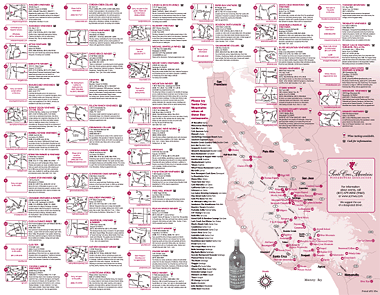
When you look at a map of the Santa Cruz Mountains, the wineries all look fairly close together….that is until you actually get up in the area. As we found out, many of the roads are single lane, deadend roads, that require you to drive long distances to see one winery, then head back to the main road, only to head up another deadend road for the next winery.

In my next article, I will share my 4-day tasting trip to the Santa Cruz Mountains, and some of the great finds of the trip.

Burgundy Basics


As I was finishing an advanced wine course with the WSET, the instructor asked me what wine region I would pick to visit, if I could only go to one place in the world, my answer was Burgundy. 

When it comes to wine, in particular French wine, there is nothing more confusing than Burgundy. Volumes of books have been written about the geology, the grape clones, the vineyard aspect, and the world famous clos. It is well known for both its red and white wines, mostly made from Pinot Noir and Chardonnay , although other grape varieties can be found, including Gamay, Aligote, Pinot Blanc, and Sauvignon Blanc. The region is divided into the Chablis, Côte d'Or, the Côte Chalonnaise, the Mâcon, and Beaujolais. The Côte d'Or is further divided into the Côte de Beaune and the Côte de Nuit. The Côte de Beaune starts between Nuits-Saint-Georges and Beaune, and runs southwards for about 25 km. The Côte de Nuit extends from Dijon to just south of Nuits-Saint-Georges. The major cities of Burgundy are Dijon, Lyons, and Beaune. The vineyards of the Cote d’Or are the undisputed upper class of Burgundy wines, as well as the most expensive.

Clos Vougeot
If you have been following this blog for a few years, you might recall my brief history of wine. The Catholic monks (Cistercian and Benedictine) populated the Côte d'Or region of Burgundy. They kept meticulous records, for hundreds of years, on where the grapes grew best. They recorded all aspects of growth, quality of the grapes, and ultimately the quality of the wine. During those many hundreds of years, the members of the church would gift their land to the church.  As people died, the first born male child inherited the land, but if there were no heirs, the church ended up with the land. The land was also “gifted”, as payment to the church.  Wine was needed for sacramental purposes, but the monks would also host travelers, including nobility, and needed wine on hand. Wine meant income and quality wine meant more income. As their holding expanded, the Catholic Church had to recognize their best vineyards. To do so, they placed rock walls around those vineyards. These rock walled vineyards are known as “clos”. They had security, patience and of course, the time, to improve viticulture.

Then along came Napoleon, and the “Napoleonic Code”.  The code gave equal inheritance to all sons versus just the first born.  Land was confiscated from the church and nobility, at the end of the revolution and declared national assets. Those who managed to retain some of their lands often broke them up and sold as well.  This led to fragmentation and multiple owners of individual vineyards.  The problem was that even within a vineyard, there are often major differences in the quality of the grapes from vine to vine. It is important to remember that the boundaries of the vineyard didn’t change, just the ownership within the walls.

Clos Vougeot ownership fragmentation
The best (or worst) example is Clos Vougeot. This 50 hectare, walled vineyard (clos) was established by the Cistercians. Clos Vougeot is a Grand Cru (more on that below).  What was once a large clos, owned by the church, is now a large clos owned by over 80 different growers, with some owning as little as one vine. The variability of the quality is wide ranged. This variability is not so much caused by the growers, but more so by the diversity of the soil, slope, and aspect.  The church understood that the top of the clos produced the best wines, and the lower slopes the most basic. Once fragmented, some got lucky, other not so much. But, they could all call their wine Clos de Vougeot. So now, you may understand where some of the challenges occur within Burgundy.

Due to the Napoleonic inheritance laws, some vineyards were so finely divided, that owning only a small portion of a high-quality single vineyard (known as “lieu-dit”) meant that a grower often had insufficient wine to vinify on his own. Négociants were needed to bottle commercial quantities of a wine. A négociant is a wine merchant who assembles the grapes or wine, of smaller growers and winemakers and sells the result under its’ own name. 

In contrast to a négociant, a “monopole” is an area controlled by a single winery, or wine company, and can be as small as a lieu-dit or as large as an entire appellation. Each wine is sold by only one company, and it is most often mentioned on the label. Whether a monopole indicates a wine of unusual quality or not is a matter of debate.

One of the other challenges of Burgundy is the structure of the AOC (Appellation d'Origine Contrôlée), now also known as AOP (Appellation d'Origine Protégée). The AOC system in Burgundy uses four designations: Regional Cru; Village Cru; Premier Cru; and Grand Cru, to indicate where the grapes were grown. As the monks knew, certain locations produced superior quality wines. While these rankings imply differing quality levels, they actually designate places that have the potential for higher quality.

Regional Cru wines are made from blends of grapes grown in vineyards within the Burgundy region. These are the simplest of the Burgundy wines, and are often labeled as Bourgogne Blanc or Bourgogne Rouge.

As you would expect, Village Cru wines are made up of a blend of grapes grown within a designated village. And, here is where some of your challenges begin. Many of the villages have changed their names, to include the most known vineyard within their village. For example, the village of Gevrey is now known as Gevrey-Chambertin (Chambertin being the name of the best known Grand Cru in the village). So, remember that just because it says “Gevrey-Chambertin” on the label, it doesn’t mean it comes from the best vineyards. These are usually entry level wines, and decent prices.

The Premier Cru appellation identifies single vineyards that have terroir with the potential for exceptional wines. These are the vineyards that were documented by the monks, and are the beginning of the upper echelon of Burgundian wines. On the wine label, there will be a designation  of Premier Cru (or 1er Cru) and then the vineyard name. Once again, you need to know the vineyard, grower, négociant or monopole, as the designation is for potential, not necessarily results.

The highest appellation in Burgundy is Grand Cru. These are vineyards, where the combination of soil, exposure and reputation offer superior potential. But, no guarantees, as quality is not a given. Only 33 vineyards in Burgundy have this designation. Only the name of the vineyard appears on a bottle of Grand Cru wine. Some of the best, and most expensive, are Chambertin, Clos de Tart, Le Musigny, Romanee-Conti, and La Tache

There is so much more to learn about Burgundy. My hope is that your takeaway from this article is that your first consideration should be the name of the producer and/or the importer. Find one you like and stick with them. People have spent their entire wine career trying to understand Burgundy. Explore, and if you are lucky enough to taste the best that Burgundy has to offer, savor it. As long as you remember that you get what you pay for, you will understand the allure of this special wine region!

Wines' Dirty Word

No it's not a four letter word, but "terroir" can sound like one to many wine drinkers and winemakers. I've used this word many times, in a number of my wine articles. But what does it mean, and why does it trigger such ugly arguments?

As you learn more, it will become obvious that terroir is a French term. And further, it will become clear that there is no true translation into the English language. The best description for terroir, that I can give, is the all encompassing "sense of place" that a wine has. It is that special mix of soil, climate, aspect of the vineyard (topography), and everything else that can affect the final grape product. All of these are unique to each vine, and remain the same every year. This sense of place contributes to the final wine produced, regardless of what is done during the winemaking process.

Let's look at the French connection, and how terroir became such an important feature of Old World wines. If you go back in history, you'll see that grapes were being grown throughout Europe, spread by the Roman Catholic Church. In particular, the Benedictine and Cistercian Monks, with their establishment of abbeys in the Burgundy region of France. These monks kept detailed records of how different plots of land produced different qualities of grapes, and ultimately wine. The best vineyards were eventually identified, and walls (or clos) were built around those plots of land. The monks knew that only certain areas produced the best product, and each plot of land had unique characteristics. They knew that there was a special terroir within each of the identified clos. The idea that unique terroir existed, spread throughout France and the European community.

Now, going back to the components of terroir, I mentioned, soil, climate, aspect, etc. As "terroir" suggests, it is tied to the soil. The soil texture, drainage, and the make up of the elements all affect the grapevine, and ultimately the grape. Limestone, granite, chalk, slate and clay are all associated with some of the great wines of the Old World. The soil can retain heat, reflect heat, drain excess moisture, or retain it. The choice of soil for planting affects the total vine.

Climate is another aspect to consider. But in the case of wine growing, it is broken down into macroclimate, mesoclimate, and microclimate. Macroclimate can be considered the regional climate, while mesoclimate is more associated with the vineyard. Microclimate is the smallest affected area. This can be a single vine, the space between the vines, or even the small area above the ground, or the canopy. All of these are affected by the aspect of the vineyard, or how the grape vines are positioned on the topography of the land. A hillside will drain better than flat land, and a southern exposure will receive more sunlight than a northern exposure. Some other things that might affect the terroir are influences by bodies of water. The Mosel, in Germany, is famous for its' hillside vineyards, that are moderated by the river. In Canada, Lake Okanogan moderates the cold region, to allow grapes to grow further north than what would be normal.

As you can tell, the word "terroir" implies all things that are natural to the place.
Where terroir becomes a "dirty word", is in the argument over whether or not it actually exists. The Old World (Europe) has based most of their wine laws on the expression of terroir. In the New World, the emphasis isn't so much on presenting a wine that shows a sense of place, but more presenting a wine that expresses the fruit. If you still are not sure what I am talking about, try a Bordeaux side by side with a Napa Cabernet Sauvignon, or a French Burgundy next to a California Pinot Noir. This also becomes part of the argument for more natural wines, with less manipulation (which we see more of in the New World...I see an entirely new blog for the future here). Some are claiming that there is no such thing as terroir, that it is merely differing levels of sulfur that are present in the juice.

I know where I stand on this, and I am a believer in terroir. I can taste subtle nuances from wines grown within the same growing region, but in different areas of that region. The best example would be Paso Robles (east versus west) or Napa versus Sonoma. Even though they are close to each other, they are all different.

So, are you a "terroirist"? Do you seek that sense of place in your wines?